

 English
 Español
 عربى
عربى
Pure White Duck Down vs Grey Duck Down: Key Differences
2026-03-13
When choosing between pure white duck down and grey duck down, the most important truth is this: color does not determine insulation performance. Both types can achieve identical fill power ratings, warmth-to-weight ratios, and loft levels. The real differences lie in sourcing constraints, product application, price positioning, and shell fabric compatibility. Understanding these distinctions helps buyers — whether sourcing for bedding, outerwear, or sleeping bags — make decisions based on actual value rather than appearance assumptions.
Content
- 1 What Pure White Duck Down Actually Is
- 2 What Grey Duck Down Is and Where It Comes From
- 3 Performance Comparison: Fill Power, Warmth, and Durability
- 4 Fill Power Grades Explained for Both Types
- 5 Cleanliness, Odor, and Down Washing Standards
- 6 Price Differences and When the Premium for White Is Justified
- 7 Practical Buying Checklist for Sourcing Duck Down
What Pure White Duck Down Actually Is
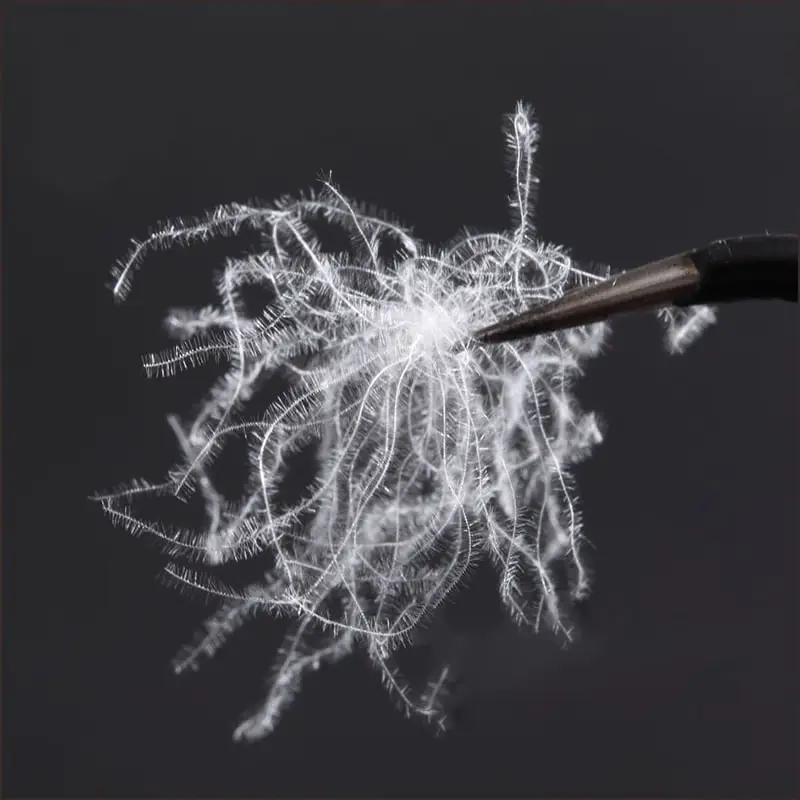
Pure white duck down is harvested primarily from white-feathered duck breeds such as the White Pekin. The defining characteristic is consistent, uniform whiteness across the down clusters — not a performance attribute, but an aesthetic and commercial one. Because white down does not show through light-colored or white shell fabrics, it commands a significant market premium in bedding and luxury apparel manufacturing.
The supply of truly pure white duck down is more limited than grey duck down, which contributes to its higher cost. Top-grade white duck down with a fill power of 700–800+ cuin is predominantly sourced from Europe (Poland, Hungary) and select farms in China where breed control is rigorous. Purity standards require that less than 5% of the down cluster content be off-white or grey to qualify as "pure white" under most commercial specifications.
Why White Down Is Preferred for Certain Products
- Invisible through white, cream, or pale shell fabrics — critical for luxury duvets and high-end fashion outerwear.
- Preferred in markets where whiteness is perceived as a quality signal, particularly in North America, Japan, and Western Europe.
- Easier to photograph and present in retail packaging without visible fill-bleed through fabric.
- Consistent color allows manufacturers to use thinner, lighter shell fabrics without compromising product appearance.
What Grey Duck Down Is and Where It Comes From
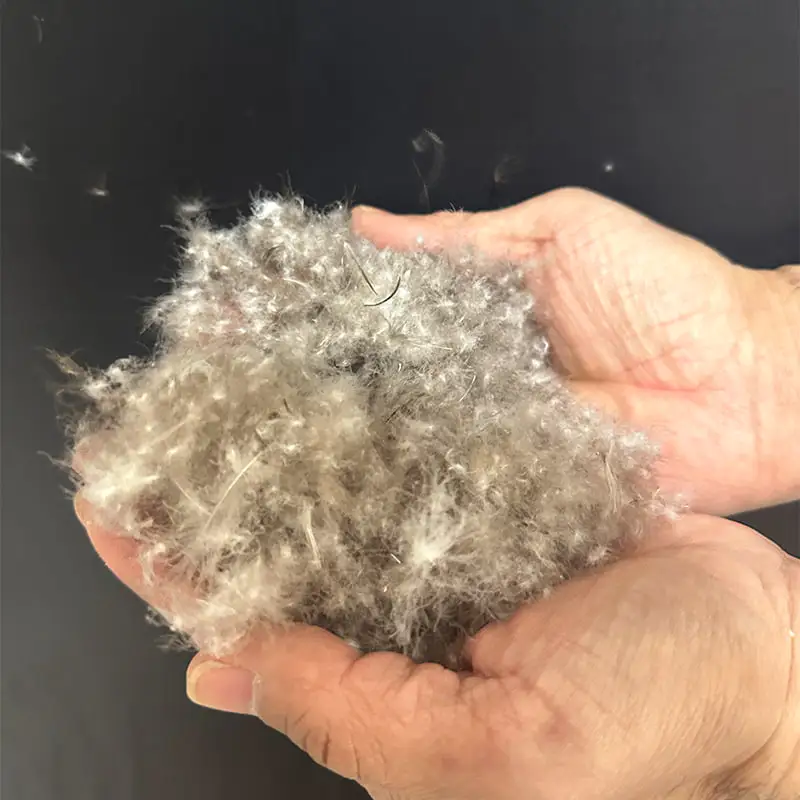
Grey duck down comes from grey or mixed-plumage duck breeds. It is far more abundant globally, as the majority of ducks raised for meat production worldwide are not white-feathered breeds. This makes grey duck down the standard filler in mid-range and value-tier bedding, workwear insulation, and outdoor gear where shell color is dark enough to mask any potential bleed-through.
Grey duck down is structurally and thermally identical to white duck down of the same fill power grade. A grey duck down fill power of 650 cuin performs the same as white duck down at 650 cuin — the same loft, the same insulation value, the same moisture recovery rate. The grey color is simply a pigmentation characteristic of the bird, not an indicator of cluster size, cleanliness, or thermal efficiency.
Applications Where Grey Down Is the Practical Choice
- Dark-shelled sleeping bags (navy, black, olive) where fill visibility is a non-issue.
- Workwear and tactical outerwear where cost-efficiency and insulation performance matter more than aesthetics.
- Budget-conscious bedding lines where the duvet cover conceals the inner duvet shell entirely.
- Bulk institutional supply (hotels, hospitals) where duvets are always used inside dark or patterned outer covers.
Performance Comparison: Fill Power, Warmth, and Durability
Fill power — measured in cubic inches per ounce (cuin) — is the single most reliable metric for comparing down insulation performance. It measures how much volume one ounce of down occupies, which directly correlates to trapped air volume and therefore warmth per unit weight. Color plays no role in this measurement.
| Attribute | Pure White Duck Down | Grey Duck Down |
|---|---|---|
| Typical Fill Power Range | 550–850+ cuin | 500–800 cuin |
| Thermal Performance (same fill power) | Identical | Identical |
| Moisture Recovery | Identical | Identical |
| Shell Fabric Compatibility | White, light, any color | Dark or opaque fabrics only |
| Relative Price Premium | 15–30% higher | Baseline |
| Supply Availability | Limited (breed-specific) | Abundant (global) |
| Durability (wash cycles) | Identical | Identical |
Both types retain approximately 85–90% of their original loft after 50 wash cycles when washed at 40°C with a down-safe detergent and dried with tennis balls to re-loft the clusters. Durability is determined by cluster integrity and washing protocol, not by color.
Fill Power Grades Explained for Both Types
Whether sourcing white or grey duck down, fill power grade is the specification that actually determines product tier. Here is how the grades translate into real-world applications:
| Fill Power (cuin) | Grade | Typical Application | Available in White / Grey |
|---|---|---|---|
| 500–549 | Entry | Budget bedding, pet beds | Both |
| 550–649 | Mid-range | Standard hotel duvets, casual jackets | Both |
| 650–749 | Premium | Quality bedding, 3-season sleeping bags | Both |
| 750–849 | High-end | Luxury duvets, performance outerwear | Predominantly white |
| 850+ | Ultra-premium | Expedition gear, flagship luxury bedding | Almost exclusively white |
The dominance of white duck down at the 750+ cuin tier is partly a supply reality: the breeds that consistently produce very large down clusters tend to be white-feathered varieties, and premium European farms have historically favored them. However, select grey duck down from cold-climate farms in China's northeastern provinces also reaches 750–780 cuin, demonstrating that breed management and climate matter more than color.
Cleanliness, Odor, and Down Washing Standards
One persistent misconception is that white duck down is inherently cleaner or less odorous than grey duck down. Down odor is caused by residual oils, proteins, and microorganisms on the clusters — not by pigmentation. Both white and grey down must pass identical turbidity and oxygen number tests to meet international cleanliness standards.
Key Cleanliness Standards That Apply to Both
- Turbidity (IDFL/EN 12935): Measures the cloudiness of water after soaking down; premium grades require a turbidity value of ≥500 mm. Color does not affect this result.
- Oxygen number: Indicates fat and protein contamination; a value below 10 mg O₂/g is required for most commercial bedding applications.
- RDS (Responsible Down Standard) and TDS (Traceable Down Standard): Both certifications apply equally to white and grey down and audit animal welfare, traceability, and processing conditions.
- OEKO-TEX Standard 100: Tests for harmful substances in the finished product; relevant for both fill colors in consumer bedding.
A well-washed grey duck down at 650 cuin will be odorless, clean, and free of residual oils. A poorly processed white duck down from an uncontrolled source will smell, regardless of its color. Always request processing certificates over relying on color as a quality proxy.
Price Differences and When the Premium for White Is Justified
At equivalent fill power grades, pure white duck down typically costs 15–30% more per kilogram than grey duck down from comparable sources. For a standard 200 × 200 cm duvet using 800 g of fill, this translates to a raw material cost difference of roughly $4–$12 per unit at wholesale, depending on grade and sourcing region. At retail, this difference is often amplified 3–5× through margin stacking.
When to Pay the Premium for White Duck Down
- The product uses a white or pale shell fabric under 200 thread count where fill bleed-through would be visible and damaging to brand perception.
- The product is positioned as luxury or premium, where the whiteness of the fill is part of the perceived quality story in marketing materials.
- The end market (e.g., Japan, Germany, high-end US specialty retail) has strong consumer preference for white fill as a quality signal.
- The outer shell will be sold ungarnished (e.g., a bare duvet insert without a cover) and displayed in retail with visible fill.
When Grey Duck Down Delivers Equal Value
- The product uses a dark, dense, or downproof shell where fill color is irrelevant.
- The duvet or jacket will always be used inside a cover or outer shell that obscures the inner product.
- Budget constraints require cost optimization without compromising thermal performance.
- The product targets performance-focused buyers (outdoor, workwear) who prioritize fill power and weight over aesthetics.
Practical Buying Checklist for Sourcing Duck Down
Whether specifying pure white duck down or grey duck down for a product line, the following checklist covers the critical variables that actually determine quality and value:
- Confirm fill power grade (cuin) tested to EN 12131 or IDFB standards — request the actual lab report, not just a label claim.
- Verify down content percentage: "90/10" means 90% down clusters and 10% feathers; higher down percentages command a premium and deliver better loft.
- Request turbidity and oxygen number certificates to confirm cleanliness and processing quality independent of color.
- Check for RDS or equivalent animal welfare certification, increasingly required by major retailers in North America and Europe.
- Assess shell fabric opacity before specifying white vs. grey — only specify white if your shell genuinely requires it.
- For high-volume orders, request production batch samples and run your own fill power and odor checks before committing.
News Center
If you are interested in our products, please consult us
Contact Details
- Address : East 1st Floor, Building 3, No.3 Light Textile Road, Xucun Town, Haining City, Jiaxing City, Zhejiang Province
- Tel: +86-18133691685
- E-mail: [email protected]
Products
Quick Link
News Center
Mobile terminal

