

 English
 Español
 عربى
عربى
What is Goose Down Fill: Fill Power, Percentage and Quality Guide
2026-08-24
Goose down fill is the soft, fluffy under-plumage harvested from the breast and underbelly of geese, nature's most efficient natural insulator. Unlike the stiff, flat feathers that form a bird's outer contour, down clusters are three-dimensional, filament-like structures that create thousands of microscopic air pockets, trapping body heat while allowing moisture vapor to escape. The result is a fill material that provides three to four times the warmth-to-weight ratio of the best synthetic alternatives, with a compressibility and resilience that synthetics have yet to replicate. From the 900-fill down in an expedition-grade mountaineering jacket to the sumptuous fill of a hotel-quality comforter, the performance of goose down is defined by measurable parameters: fill power, down percentage, and the species and region of origin. Understanding these parameters is the key to distinguishing genuinely high quality goose down from inferior blends and to appreciating why a kilogram of premium white goose down can command a price that reflects its exceptional thermal and durability characteristics.
Content
- 1 The Biological Structure of Goose Down and Why It Insulates
- 2 White Goose Down and Regional Variation in Down Quality
- 3 Goose Down Fill Power: The Definitive Measure of Quality
- 4 Goose Down Percentage and the Down-to-Feather Ratio
- 5 Goose Down for Jackets: Fill Weight, Baffling, and Performance
- 6 Goose Down for Bedding: Comforters, Pillows, and the Luxury Sleep Experience
- 7 The Supply Chain of Quality: Processing, Cleaning, and Certification
The Biological Structure of Goose Down and Why It Insulates
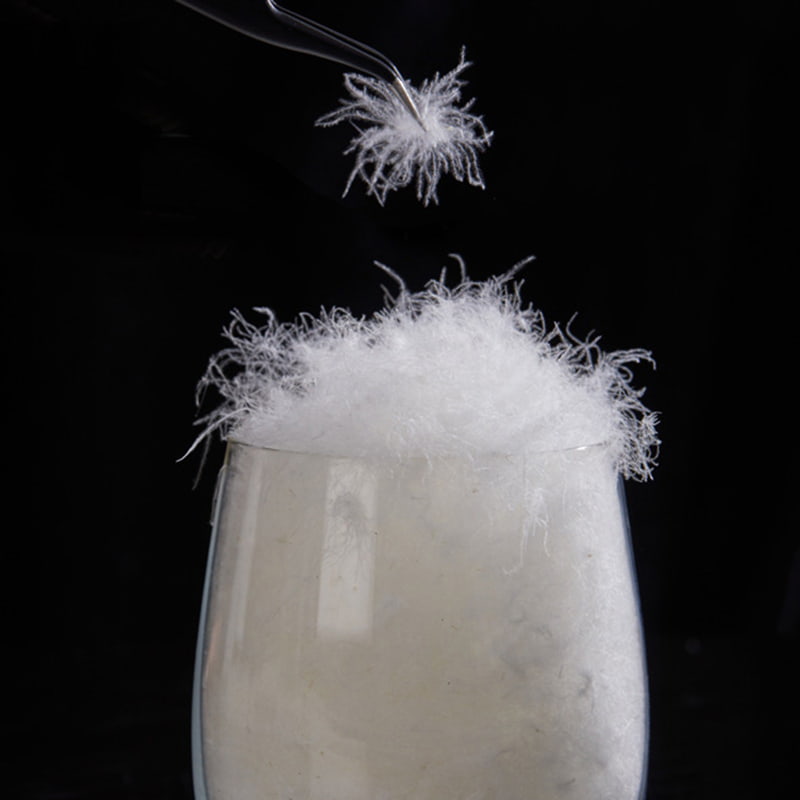
To understand goose down filling material, it is helpful to examine a single down cluster under magnification. The cluster consists of a central point from which thousands of fine, branching filaments radiate in three dimensions, forming a roughly spherical structure. Each filament carries even smaller barbules that interlock loosely with those of neighboring clusters, creating a cohesive, elastic mass that resists compression and springs back when the load is removed. This three-dimensional architecture is what gives down its loft—the ability to expand and hold a volume of air. Air is a poor conductor of heat, so the more air a given weight of down can trap, the better it insulates. The cluster structure also allows moisture vapor from the body to pass through the spaces between filaments, preventing the clammy buildup that occurs inside vapor-impermeable insulations. This combination of high warmth, minimal weight, breathability, and the ability to be compressed into a small volume for storage has made natural down insulation material the gold standard for cold-weather apparel and luxury bedding.
White Goose Down and Regional Variation in Down Quality
White goose down is the preferred raw material for premium garments and bedding for both aesthetic and functional reasons. White down does not show through light-colored shell fabrics the way darker grey goose down or duck down can, allowing designers to use thinner, lighter-weight outer materials without sacrificing appearance. Beyond color, the quality of goose down varies significantly with the bird's breed, age, and the climate in which it was raised. Mature geese raised in colder regions develop larger, more resilient down clusters with higher fill power to protect themselves from the elements. Historically, regions with a tradition of goose farming—such as parts of Hungary, Poland, and Canada—have been associated with exceptionally high-grade pure white goose down. The down is collected as a byproduct of the food industry, cleaned through a multi-stage washing process that removes dust, oils, and allergens, and then sterilized to meet strict hygiene standards. Certified down, such as that verified by the Responsible Down Standard (RDS), provides traceability back to farms that avoid live-plucking and force-feeding, an increasingly important consideration for consumers seeking ethically sourced goose down for bedding and apparel.
Goose Down Fill Power: The Definitive Measure of Quality
Goose down fill power is the laboratory measurement that defines how much space one ounce of down occupies when allowed to loft to its maximum volume under controlled conditions. The test involves placing a conditioned sample of down into a cylinder, applying a standardized weight to compress it, then measuring the volume it occupies in cubic inches. The resulting number—commonly ranging from 500 to 900+—is the single most reliable indicator of down quality and thermal efficiency. A higher fill power means each ounce of down traps more air and provides more warmth for less weight. The table below illustrates how fill power correlates with performance and typical applications.
| Fill Power (in³/oz) | Quality Grade | Typical Cluster Size | Best Application |
|---|---|---|---|
| 500–550 | Economy | Small, less resilient clusters | Budget comforters, casual jackets for mild conditions |
| 600–650 | Good | Medium clusters with fair resilience | General-use jackets, mid-range comforters and pillows |
| 700–750 | Very Good | Large, resilient clusters from mature birds | Performance outerwear, high-end sleeping bags, luxury bedding |
| 800–900+ | Exceptional | Very large, fully mature clusters | Expedition gear, ultralight mountaineering, heirloom-quality comforters |
It is important to note that fill power is measured on pure down after it has been separated from feathers and conditioned. Two jackets with identical fill power can perform very differently if one contains a higher percentage of actual down clusters versus feathers. This is why goose down percentage is the second critical number on a product label.
Goose Down Percentage and the Down-to-Feather Ratio
Goose down percentage specifies what proportion of the fill is down clusters as opposed to feathers, feather fibers, and other residual matter. This is typically expressed as a ratio—for example, 80/20, 90/10, or 95/5—where the first number is the minimum down cluster content by weight. Products labeled simply as "down" in many jurisdictions must legally contain at least 75% down clusters, with the remainder being feathers and feather fibers. A "pure" or "premium" down product may be labeled 90/10 or 95/5, indicating that 90% or 95% of the fill consists of the highly insulating down clusters. The feathers that remain in lower-ratio fills provide some structure and support—which can be desirable in a firmer pillow—but they contribute far less warmth per unit weight and can have quills that poke through the fabric shell. For goose down for jackets, a 90/10 or higher ratio is desirable because it maximizes warmth for the weight and allows the jacket to compress into a small pack volume. For down filling for comforters, a 90/10 or 95/5 ratio combined with a fill power of 700 or above produces a comforter that is simultaneously light, lofty, and thermally efficient—qualities that define a high quality goose down bedding product.
Goose Down for Jackets: Fill Weight, Baffling, and Performance
In the context of goose down for jackets, the fill power, fill weight, and the garment's construction work together to determine warmth. Fill weight is simply the total weight of down inside the jacket, measured in grams. A jacket with 120 grams of 800-fill down will be warmer and lighter than a jacket with 120 grams of 600-fill down, because the higher fill power down traps more air per gram. However, a jacket with 200 grams of 600-fill down might be warmer overall, albeit heavier. The relationship is linear: warmth is approximately proportional to the product of fill power and fill weight. The baffle construction—the internal compartments that hold the down in place—is equally important. Sewn-through baffles are lighter and less expensive but create cold spots at the seam lines. Box baffles, which use internal mesh walls to allow down to loft fully between the inner and outer fabric layers, eliminate cold spots and are specified for down filling material in expedition and severe-weather jackets. A well-made down jacket will also use a tightly woven, down-proof shell fabric that prevents the fine down filaments from escaping while remaining breathable enough to allow moisture vapor to pass through.
Goose Down for Bedding: Comforters, Pillows, and the Luxury Sleep Experience
Goose down for bedding transforms the sleep experience by providing warmth without weight, a quality that synthetic fills struggle to match. A down filling for comforters is typically specified by both fill power and fill weight, and the two together determine the comforter's thermal range. A summer-weight comforter might use 400 grams of 600-fill down, while a winter-weight luxury comforter might use 700 grams of 800-fill pure white goose down to create a cloud-like layer that insulates effectively even in a cold bedroom. The shell fabric of the comforter—ideally a long-staple cotton with a thread count of 300 to 400—must be tightly woven enough to contain the down while remaining soft and quiet. Down pillows present a different set of requirements. A higher feather content (a lower down percentage) in a pillow provides more structural support and firmness, which some side sleepers prefer, while a high down percentage pillow offers a soft, moldable feel. The sourcing and processing of the down for bedding is particularly important because users spend a third of their lives with their face and respiratory system in close contact with the material. Certified, thoroughly washed, and hypoallergenic high quality goose down is the standard for luxury hotel bedding and home collections, where the combination of superior insulation, moisture management, and enduring loft creates a sleep environment that synthetics cannot replicate.
The Supply Chain of Quality: Processing, Cleaning, and Certification
The journey from raw goose down to a finished down filling material involves a rigorous multi-stage industrial process. After collection, the raw down is sorted to remove coarse feathers and debris, then washed repeatedly at high temperatures with specialized detergents to remove natural oils, dust, and organic matter. The washing process must balance cleanliness with the preservation of the down's natural structural integrity; overly aggressive washing can damage the filaments and reduce fill power. After washing, the down is dried, sterilized—often with steam at temperatures exceeding 120°C—and then graded by fill power and cluster content using mechanical classifiers and skilled human inspection. The final product is packaged in compressed bales for transport to apparel and bedding manufacturers. Throughout this process, third-party certifications provide transparency and assurance. The Responsible Down Standard (RDS) certifies that the down comes from birds that were not subjected to live-plucking or force-feeding. The OEKO-TEX Standard 100 certifies that the finished down is free from harmful substances. For the consumer, these certifications are the guarantee that the natural down insulation material inside a jacket or comforter meets both ethical and safety standards. Understanding the full supply chain—from the mature goose in a cold climate to the sterilized, graded fill—reinforces why authentic, high-quality goose down commands its price and remains the preferred insulation for those who demand the best warmth, breathability, and durability from their outdoor gear and home textiles.
News Center
If you are interested in our products, please consult us
Contact Details
- Address : East 1st Floor, Building 3, No.3 Light Textile Road, Xucun Town, Haining City, Jiaxing City, Zhejiang Province
- Tel: +86-18133691685
- E-mail: [email protected]
Products
Quick Link
News Center
Mobile terminal

