

 English
 Español
 عربى
Home / News / Industry News / Cost-Effective Hotel Down Quilt Filling: Specs, Costs and Laundry Proof

Cost-Effective Hotel Down Quilt Filling: Specs, Costs and Laundry Proof
2026-10-30
A 200-room hotel replaced 420 quilt inserts twice in three years. Nothing in the ticking failed. The filling was 50% white duck down bought at the lowest price per kilogram, laundered at 80 degrees Celsius, dried on a commercial line, and pressed flat long before its service life was supposed to end.
That replacement bill, not the invoice per kilogram, decides whether hotel down quilt filling is cheap or expensive. Cost-effective hotel down quilt filling is a specification question: how much down content, how much fill weight, and how clean the raw material is, measured against the laundry cycle your property actually runs.
Content
- 1 What Cost-Effective Hotel Down Quilt Filling Actually Means
- 2 Matching Hotel Down Quilt Filling Spec to Property Tier and Season
- 3 Does Higher Down Content Always Cost More? The Equal-Warmth Trade-Off
- 4 High-Temperature Drying Is the Test Most Hotel Buyers Skip
- 5 How to Vet a Filling Supplier Before You Commit to a Container
- 6 Where a Cheap Quilt Filling Turns Expensive
- 7 Frequently Asked Questions About Cost-Effective Hotel Down Quilt Filling
What Cost-Effective Hotel Down Quilt Filling Actually Means
Cost-effective hotel down quilt filling is a filling specification that holds its loft through repeated high-temperature laundering while keeping the total cost per night of service low. Price per kilogram on its own predicts nothing.
Working definition
A cost-effective hotel down quilt filling keeps a 240 x 220 cm quilt inside its original thermal range for at least 30 industrial wash-and-dry cycles, at the lowest combined cost of material, laundry energy and replacement.
Four values on a supplier datasheet control that outcome:
- Down content: the share of down clusters against feather. An 80% down and 20% feather blend is the usual midscale anchor; a 50% blend costs less per kilogram but needs far more weight to reach the same warmth.
- Fill power: loft measured in cubic inches per 30 g. Hotel quilts want 600 cuin or higher so the clusters still trap air after washing.
- Fill weight: grams per quilt. A low-loft blend needs 30% to 45% more weight to match a higher grade, and that is where the real invoice grows.
- Cleanliness values: oxygen number, capped at 10 mg per 100 g, and turbidity, floored at 400 mm, under IDFB and EN 12935 test methods. Under-washed material fails both and later shows up as odour in humid storage.
80%Down content anchor for midscale properties
600 cuinMinimum fill power for repeated laundering
10 mgOxygen number ceiling per 100 g of filling
400 mmTurbidity floor for clean, odour-free down
Matching Hotel Down Quilt Filling Spec to Property Tier and Season
Match the filling to the laundry you run and the season you sell, not to the star rating on the door. A 50% blend pushed through an 80 C drying line is the most common false economy in hotel bedding procurement.
| Property tier and season | Filling choice | Down content | Fill weight | Expected service life |
| Economy hotel, hostel, all-season | White duck down | 50% | 1,300 to 1,500 g | 18 to 24 months |
| Midscale business, all-season | White duck down | 80% | 1,000 to 1,150 g | 30 to 36 months |
| Upper midscale, winter | White duck down | 90% | 850 to 1,000 g | 36 to 48 months |
| Boutique, cold-climate winter | White goose down | 90% | 750 to 900 g | 48 months and above |
Two operational notes matter more than the table itself. Winter weight does not mean winter down content: a cold-climate property is usually better served by adding 150 g to 200 g of fill weight than by jumping to a costlier grade. Laundry capacity sets the other ceiling, because a heavier insert dries more slowly and lines already running at full capacity feel that within one season.
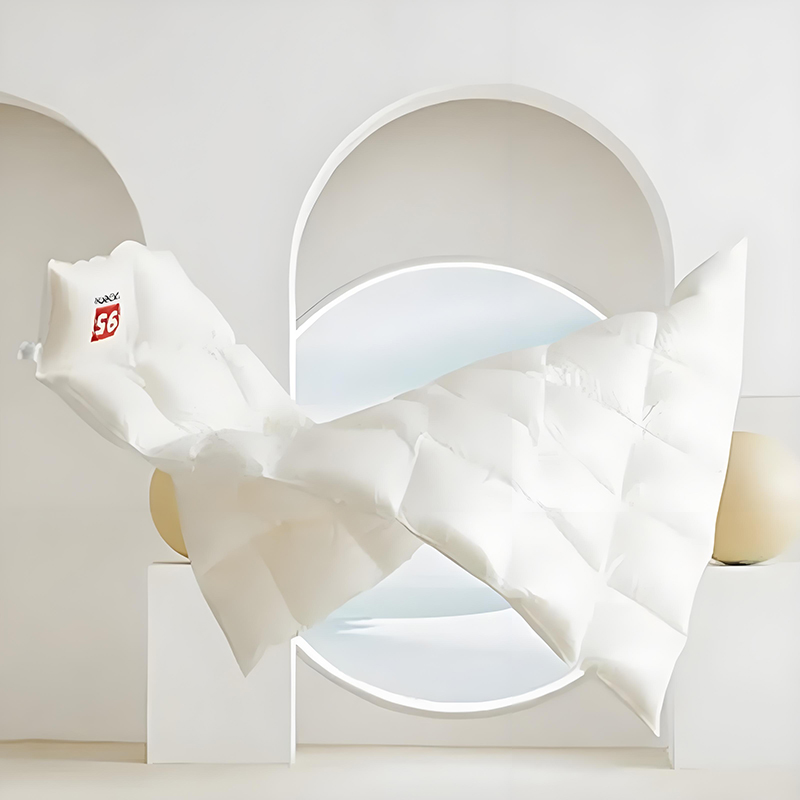 Hotel Down Quilt Filling for All-Season UseCost-effective hotel down quilt filling for frequent guest use and all-season warmth, with high-temperature drying and low maintenance in laundry cycles.View Product →
Does Higher Down Content Always Cost More? The Equal-Warmth Trade-Off
No. At equal measured warmth, lower down content is cheaper at the point of purchase and more expensive across a three-year cycle, because the extra fill weight you pay for shows up twice: on the material invoice and on the laundry meter.
36-month cost of ownership index per hotel quilt, 50% white duck down = 100
Indexed planning model combining material price per kilogram, laundry energy per cycle and replacement frequency over 36 months at 80 C drying.
The low-loft route: 50% blend at 1,450 g
- Lowest material cost per quilt at the point of purchase
- Heavier insert that slows every laundry cycle
- Loft loss that typically forces replacement inside 24 months
The higher-loft route: 80% blend at 1,100 g
- Roughly 18% more material cost per quilt
- 24% less fill weight to launder and dry
- Service life of 30 to 36 months in the same laundry line
Run the ratio before you run the tender. On a 240 x 220 cm quilt, 1,100 g of 80% white duck down delivered the same measured warmth as 1,450 g of a 50% blend, cut roughly a quarter of the energy cost per cycle, and reduced replacement from two inserts to one over 36 months.
 80% Pure White Duck Down FillingNatural duck down filling with 80% down content, selected from abdomen, neck, and wings for soft, breathable, temperature-regulating insulation in woven garments.View Product →
High-Temperature Drying Is the Test Most Hotel Buyers Skip
If your laundry dries above 70 C, the filling's cleanliness values and cluster structure matter more than its headline fill power.
Commercial laundries run 70 C to 90 C drying, and heat, moisture and mechanical tumbling attack the filling at once. Natural oils left in under-washed down oxidise under that load, which is what produces the sour smell guests report in month three or four, not the ticking. Fat content above 1.5% and an oxygen number close to the 10 mg ceiling are early warnings of exactly that failure, and neither shows up on a fill power certificate.
30
The number of industrial wash-and-dry cycles a hotel filling should be proven against before a purchase order is signed. A supplier quoting 60 C loft data for an 80 C laundry line is answering a different question.
Loft behaviour under repeated drying depends heavily on baffle construction and cluster retention, which is covered in this guide to thick down quilt filling.
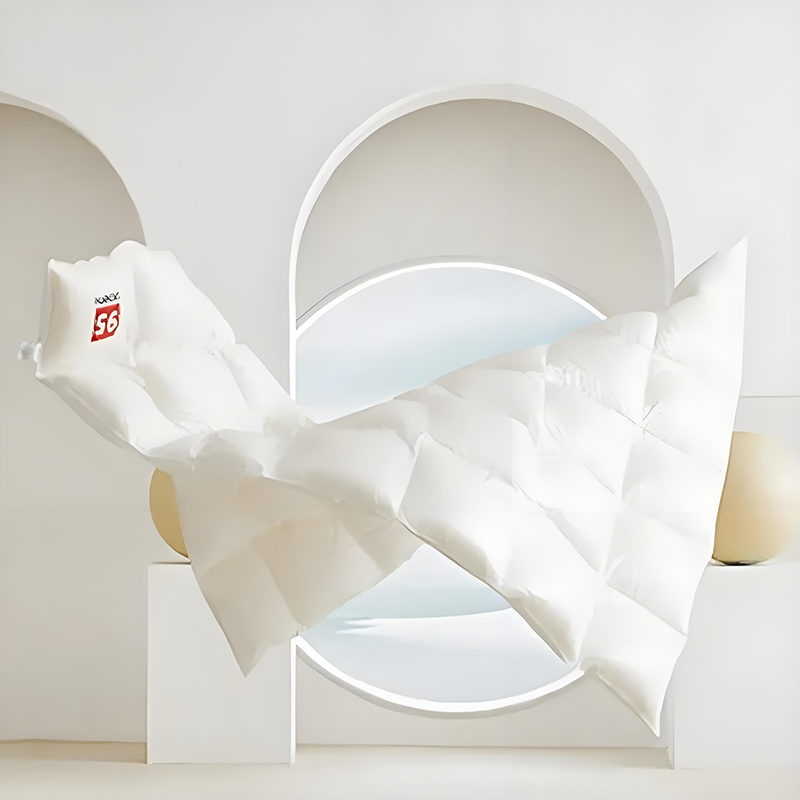 High-Down-Content Thick Winter Duvet FillingSelected white duck down from abdomen, neck, and wings for thick winter quilts, offering warmth, light softness, loft rebound, and antibacterial anti-mite treatment.View Product →
How to Vet a Filling Supplier Before You Commit to a Container
Test three things before a container ships: cleanliness values, loft retention after drying, and consistency between the sample and the production lot.
Pull 3 kg per grade, not per supplier
Oxygen number, turbidity, moisture and fat content shift from lot to lot. A single reference sample tells you nothing about the batch that will fill your order.
Wash and dry 10 cycles on your own settings
Measure loft before and after. If the measurement drops more than 10%, the filling will not survive the 30-cycle target in a real hotel laundry.
Weigh the fill inside finished quilts
Invoice specifications and actual fill weight commonly differ by 5% to 10%, and the gap only becomes visible after the first wash.
Match certification documents to the lot number
Traceability paperwork that does not line up with the shipped lot is where export orders stall at inspection.
Run a 20-quilt pilot in one wing
One season of real occupancy exposes odour, migration and loft loss faster than any laboratory report.
For the questions that come up most often during sourcing, the down filling sourcing questions section covers lot tolerances, minimum order quantities and documentation.
Where a Cheap Quilt Filling Turns Expensive
Cheap filling rarely fails in the showroom. It fails in five places.
- Loft collapse inside two laundry seasons, because 50% blends carry more feather fibre that mats under heat.
- Odour appearing after humid storage, traced to an oxygen number near the 10 mg limit rather than to the ticking.
- Cluster migration through low-density ticking, which turns a warm quilt into a cold one within a year.
- Fill weight shortfalls of 5% to 10% against the signed specification, invisible on delivery and obvious after one wash.
- Certification paperwork that does not match the shipped lot, which stops an export order at inspection.
Five failure points, one root cause: filling bought on price per kilogram instead of cost per night of service.
Frequently Asked Questions About Cost-Effective Hotel Down Quilt Filling
What down content is the most cost-effective for hotel quilts?
For properties running a commercial laundry, 80% white duck down is the most cost-effective starting point. It uses roughly 25% less fill weight than a 50% blend for the same measured warmth, dries faster, and holds loft for 30 to 36 months instead of 18 to 24.
How long should hotel down quilt filling last?
Plan for 30 to 36 months of service from an 80% blend and 18 to 24 months from a 50% blend when quilts are washed and dried at commercial temperatures. Anything shorter points to a cleanliness or fat content problem rather than normal wear.
Is 50% duck down good enough for hotel quilts?
It is serviceable for economy properties and short-stay hostels where inserts are laundered less often. In an all-season property with high occupancy, the extra fill weight and faster loft loss usually erase the saving within two replacement cycles.
Does hotel down quilt filling need high-temperature washing?
Most hotel laundries run 60 C to 80 C wash programmes with drying above 70 C for hygiene compliance, so the filling must be specified for that load. Ask suppliers for loft retention data at your own wash temperature and cycle count, not at a laboratory default.
News Center
If you are interested in our products, please consult us
Contact Details
- Address : East 1st Floor, Building 3, No.3 Light Textile Road, Xucun Town, Haining City, Jiaxing City, Zhejiang Province
- Tel: +86-18133691685
- E-mail: [email protected]
Products
Quick Link
News Center
Mobile terminal

