

 English
 Español
 عربى
عربى
Goose Down Feathers & Bird Down Explained: Types, Quality & Uses
2026-04-02
Content
What Down of a Bird Actually Is — and Why It Differs From Feathers
Down feathers are the soft, fluffy underlayer found beneath the outer contour feathers of waterfowl and certain other birds. Unlike feathers, which have a rigid central quill and flat, interlocking barbs designed for flight and weather protection, down clusters have no quill shaft. Instead, they consist of a central point from which hundreds of fine, branching filaments radiate in three dimensions — creating a lightweight three-dimensional structure that traps large volumes of warm air relative to its weight.
This structural difference is what makes down one of the most efficient natural insulators known. A single mature goose down cluster can trap more than 800 times its own weight in air. The air pockets formed between and within clusters resist heat conduction, slowing the transfer of body heat to the cold environment outside a sleeping bag or jacket. No synthetic insulation currently matches down's warmth-to-weight ratio at equivalent loft, though synthetics hold advantages in wet conditions where down clusters collapse and lose insulating capacity.
Consumer products labeled "down" legally contain a minimum percentage of true down clusters, with the remainder being small feathers and fiber. In the United States, the Federal Trade Commission requires that products labeled simply as "down" contain at least 75% down clusters by weight. Products labeled "100% down" must contain no feathers at all — a meaningful quality distinction reflected in price.
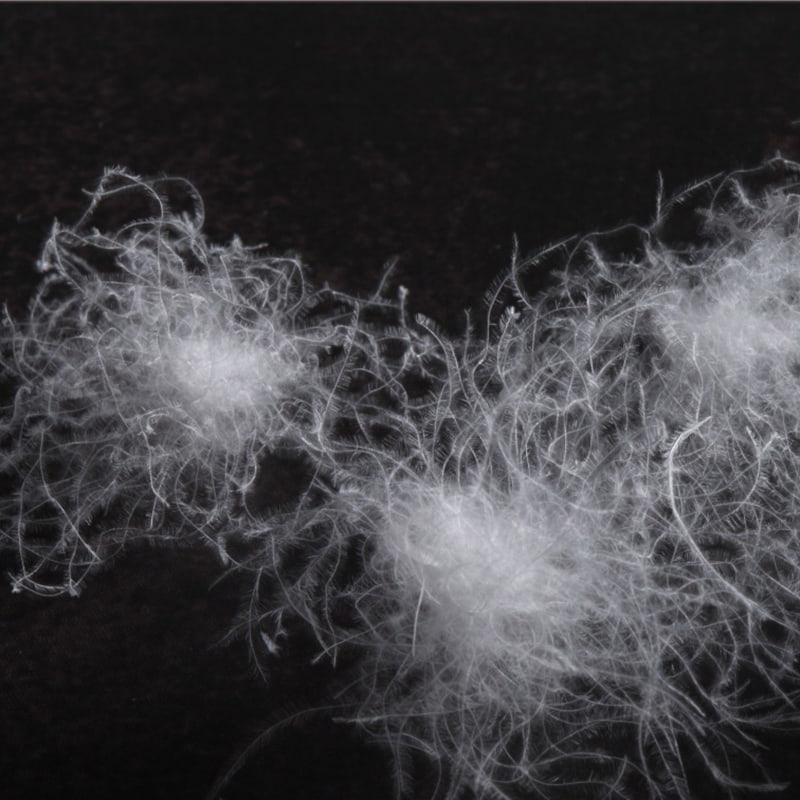
Goose Down Feathers vs. Duck Down: What the Difference Means in Practice
Goose down feathers are generally larger in cluster diameter than duck down, which directly translates to higher fill power at equivalent weight. Geese are larger birds than most commercial duck breeds, and their down clusters reach full size later in the bird's maturity — mature goose down from cold-climate birds such as Hungarian, Polish, or Siberian geese consistently achieves fill power ratings of 700–900+, while standard duck down typically ranges from 550–700.
The practical implication is loft per ounce: to achieve the same warmth rating, a product filled with 550-fill duck down requires significantly more fill weight than one using 800-fill goose down, resulting in a heavier and bulkier end product. For applications where packability and weight are critical — alpine sleeping bags, expedition down jackets, ultralight quilts — high-fill-power goose down is the material of choice despite its cost premium.
Duck down is not inferior in absolute terms — it provides excellent insulation for bedding applications where weight and packability are less critical, and it is significantly more available globally since ducks are raised in much higher numbers than geese. Premium duck down, particularly from cold-climate Eider or Muscovy ducks, can approach goose down performance, though true Eider down — collected from wild nest linings in Iceland — commands exceptional prices and is rarely found outside specialty European bedding.
| Down Type | Typical Fill Power Range | Cluster Size | Best Application |
|---|---|---|---|
| Premium Goose Down | 750–900+ | Large | Expedition gear, ultralight apparel |
| Standard Goose Down | 600–750 | Medium–Large | Bedding, mid-range outerwear |
| Premium Duck Down | 600–700 | Medium | Bedding, everyday jackets |
| Standard Duck Down | 450–600 | Small–Medium | Budget bedding, casual apparel |
Reading Fill Power and Fill Weight Together
Fill power measures how much volume one ounce of down is it capable of occupying — expressed in cubic inches per ounce (cuin) under standardized test conditions. A fill power of 800 means one ounce of that down expands to fill 800 cubic inches of space. Higher fill power means larger, more mature clusters with greater loft per unit weight.
Fill power alone does not determine warmth — fill weight (the total amount of down used in a product) is equally important. A sleeping bag using 800-fill down at 12 ounces total fill provides more insulation than one using the same 800-fill down at 6 ounces. Marketing that emphasizes fill power without disclosing fill weight is a common tactic for making lightly filled products appear warmer than they are. Always look for both figures when comparing performance products.
For bedding, fill weight is typically expressed as grams per square meter (GSM) of the comforter or duvet. A summer-weight duvet might use 150–200 GSM fill; an all-season duvet 250–350 GSM; and a winter-weight duvet 400–600 GSM. Higher fill power down at a given GSM will produce a loftier, lighter comforter — but the warmth is primarily determined by the GSM, with fill power influencing how light and breathable the finished product feels at that warmth level.
Care, Longevity, and the Biggest Mistakes That Damage Down
Down products that are well maintained retain their loft and performance for 15–25 years — significantly longer than synthetic-filled alternatives. The most common causes of premature performance loss are moisture damage, improper washing, and inadequate drying.
Moisture is the primary enemy of down in use. Clusters collapse when wet, losing most of their insulating air space. In sleeping bags and jackets, moisture enters both from external precipitation and from body perspiration vapor that condenses within the insulation layer over time. Shell fabrics with a durable water repellent (DWR) finish slow external moisture ingress; down treated with hydrophobic coatings (often marketed as "treated down" or under brand names like DownTek or DriDown) resists moisture absorption at the cluster level, recovering loft faster after light wetting and maintaining partial insulation when damp.
When washing down products, the critical rules are:
- Use a front-loading washing machine — top-loaders with agitators can tear baffles and damage clusters.
- Use a down-specific or gentle detergent at low temperature; standard detergents strip the natural oils from down filaments, reducing flexibility and loft recovery.
- Dry thoroughly at low heat with dryer balls — incomplete drying leaves moisture trapped in clusters, which causes mildew and permanent cluster damage. Multiple drying cycles are often necessary for thick duvets or sleeping bags; the product should feel fully lofted with no damp clumps before storage.
- Store uncompressed in a breathable cotton storage bag — long-term compression in stuff sacks degrades cluster structure over time, reducing loft recovery capacity.
News Center
If you are interested in our products, please consult us
Contact Details
- Address : East 1st Floor, Building 3, No.3 Light Textile Road, Xucun Town, Haining City, Jiaxing City, Zhejiang Province
- Tel: +86-18133691685
- E-mail: [email protected]
Products
Quick Link
News Center
Mobile terminal

