

 English
 Español
 عربى
عربى
Goose Down vs Duck Down: Warmth, Feathers, and Alternatives Compared
2026-06-02
Content
- 1 What Is Down? Goose Down, Duck Down, and Waterfowl Down Explained
- 2 Is Duck Down as Warm as Goose Down?
- 3 Goose Down vs. Duck Down: A Detailed Comparison
- 4 Down vs. Feather: What's the Difference in a Duvet or Comforter
- 5 What Is Goose Down Alternative Made Of?
- 6 Goose Down Comforter vs. Alternative: Which Should You Choose?
What Is Down? Goose Down, Duck Down, and Waterfowl Down Explained
Down is the soft, fluffy underlayer of insulation found beneath the outer feathers of waterfowl — geese, ducks, and similar birds. Unlike feathers, which have a rigid central quill and flat vanes, down clusters are three-dimensional, branching structures with no quill. Each cluster traps a large volume of still air relative to its weight, which is what makes down one of the most efficient natural insulators known.
Waterfowl down is the collective term for down sourced from any water-associated bird, including geese, ducks, and eider ducks. In commercial bedding and outerwear, virtually all waterfowl down comes from geese or ducks, with geese and ducks raised primarily for meat and foie gras production, with down collected as a byproduct.
Goose down specifically refers to down harvested from geese. Goose down clusters are generally larger than duck down clusters because geese are bigger birds and grow in colder climates that require thicker insulation. Larger clusters mean more loft (volume) per unit of weight — which is why goose down typically commands a premium over duck down at equivalent fill power ratings.
Duck down comes from ducks and is the more abundantly available of the two. It performs very well as bedding and insulation fill at lower price points. The practical warmth difference between quality duck down and quality goose down at the same fill weight is smaller than most buyers expect — the species distinction matters less than fill power and fill weight, which are discussed below.
Is Duck Down as Warm as Goose Down?
Duck down can be just as warm as goose down — but the comparison requires a qualifying condition: fill power must be equal. Fill power (measured in cubic inches per ounce, or cuin) is the standardized metric for down loft, which directly determines insulating performance. A duck down product rated at 700 fill power provides the same warmth-to-weight ratio as a goose down product rated at 700 fill power.
The practical distinction is that goose down more commonly achieves very high fill power ratings (700–900+ cuin) because of the larger cluster size advantage. Premium duck down typically tops out around 700–750 cuin in commercial products, while the highest-grade goose down (Siberian white goose, Hungarian white goose) reaches 850–900+ cuin. At these extreme levels, goose down products can be made measurably lighter for the same warmth — which matters most for performance outdoor gear, less so for bedding where weight is secondary.
For comforters and duvets used in home bedding, a 600–700 fill power duck down product at the right fill weight performs identically to equivalent goose down for most sleepers. The warmth gap only becomes practically relevant above 750 fill power, where the price premium for goose down becomes substantial.
Goose Down vs. Duck Down: A Detailed Comparison
| Factor | Goose Down | Duck Down |
|---|---|---|
| Cluster size | Larger (geese are bigger birds) | Smaller on average |
| Typical fill power range | 550–900+ cuin | 450–750 cuin |
| Odor | Milder; less noticeable when wet | Slightly stronger, especially in humid conditions |
| Price | Higher; premium grades significantly more expensive | More affordable at equivalent fill weights |
| Supply availability | Less abundant | More abundant globally |
| Warmth at equal fill power | Identical | Identical |
| Best use case | Ultra-lightweight performance gear, premium bedding | Value bedding, mid-range outerwear and duvets |
White Goose vs. White Duck Down
Color is a practical consideration mainly for light-colored shell fabrics. White down — from white geese (Hungarian, Polish, Siberian) or white ducks — does not show through pale or white fabric covers the way grey or brown down can. In high-thread-count white duvet covers and luxury bedding, white down is specified to prevent dark flecks showing through the shell. In terms of warmth or loft performance, white and grey down from the same species at the same fill power are functionally identical. The white premium is a fabric compatibility issue, not a performance one.
Down vs. Feather: What's the Difference in a Duvet or Comforter
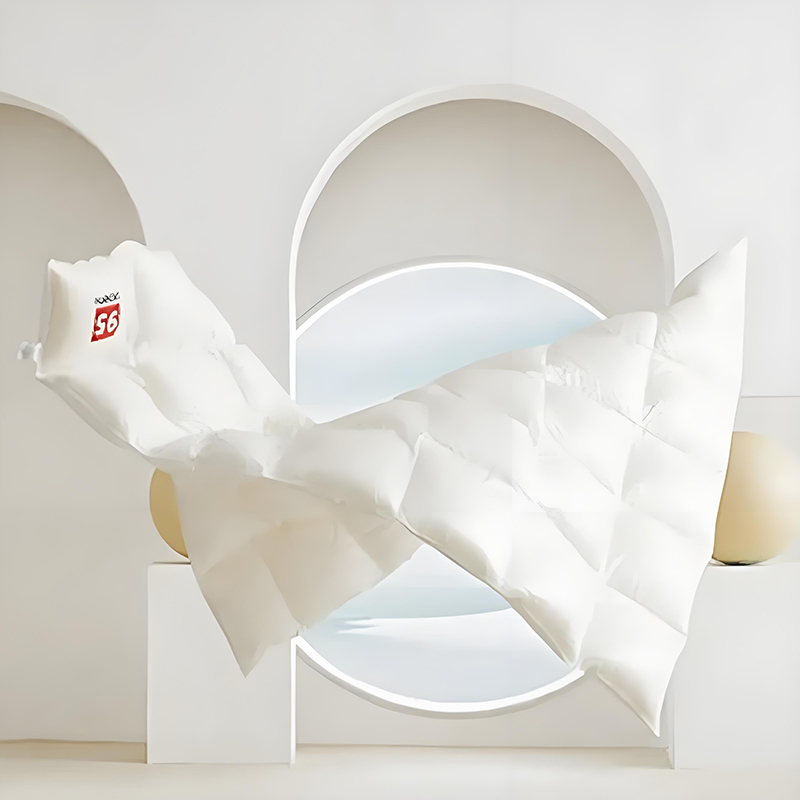
Down and feathers come from the same birds but are structurally different materials with very different performance profiles. Most bedding products sold as "down" actually contain a blend of down and feathers — reading the fill composition label is essential to understanding what you are buying.
- Down clusters are three-dimensional, quill-free, and highly compressible. They trap air efficiently and spring back to full loft after compression. A duvet filled with pure down is light, warm, and has excellent drape.
- Feathers have a flat, two-dimensional structure with a rigid central quill. They add weight and body to a product but contribute relatively little insulation per gram. Feathers can quill-poke through fabric over time, which is why feather-heavy duvets may eventually require a tightly woven down-proof shell.
- Typical blend ratios in retail bedding range from 50/50 down-to-feather (budget, heavier, less warm) to 90/10 or 95/5 (premium, lighter, warmer). A product labeled "100% down" may legally contain up to 10% feather fiber in many markets — check the standard the manufacturer references.
- Down vs. feather duvet performance: a 90/10 down/feather duvet at the same fill weight as a 50/50 blend will be noticeably warmer and lighter because the higher proportion of down clusters provides more loft per gram. Feather-heavy duvets are less expensive and feel firmer and more substantial — some sleepers prefer the weighted sensation.
What Is Goose Down Alternative Made Of?
Goose down alternatives are synthetic fills engineered to replicate the loft, softness, and warmth of natural down without using animal-sourced materials. They are the standard choice for people with down allergies, ethical objections to animal products, or budgets that preclude premium down pricing.
The most common down alternative materials are:
- Polyester fiberfill (standard) — The most widely used synthetic fill. Fine polyester fibers are crimped or spiralized to create bulk and loft. Standard polyester fiberfill is significantly cheaper than down but compresses more permanently over time and does not breathe as well. Thread counts and cluster sizes vary widely across budget and mid-range products.
- Microfiber down alternative — Finer-denier polyester (often 0.9 denier or below) that more closely mimics the soft hand and drape of natural down. Microfiber fills are lighter and softer than standard polyester and are used in premium alternative products.
- Cluster-fiber fills (PrimaLoft, Climashield, Thermoball) — Branded synthetic technologies that engineer individual fiber clusters or continuous filament structures to approximate down cluster geometry. These are used primarily in performance outerwear but increasingly appear in bedding marketed as high-performance alternatives. PrimaLoft retains more insulating value when wet than natural down — a significant advantage in outdoor applications.
- Lyocell and modal fiber fills — Plant-derived cellulosic fibers used in some natural/vegan alternatives. Less common, softer hand than polyester, but lower loft recovery after repeated washing.
- Recycled polyester fills — Increasingly specified in sustainability-focused bedding lines, made from post-consumer PET plastic. Performance is comparable to virgin polyester fills; the distinction is primarily environmental.
Goose Down Comforter vs. Alternative: Which Should You Choose?
The decision between a goose down comforter and a down alternative comes down to four factors: warmth, allergies, care requirements, and budget.
Warmth and Loft Over Time
Natural down — both goose and duck — outperforms synthetic alternatives in loft recovery over the long term. A quality goose down comforter at 600+ fill power will maintain its loft for 10–20 years with proper care, while most synthetic alternatives begin to lose loft and clump after 3–5 years of regular use. For long-term cost-per-year calculations, premium down often wins despite the higher upfront price.
Allergies
True down allergies are less common than widely assumed — most people who react to down bedding are actually reacting to dust mites that colonize the fill, or to poorly cleaned down that retains protein residues. Properly washed, high-quality down (look for products certified by the Downpass or RDS — Responsible Down Standard — which require thorough cleaning) causes far fewer reactions than budget down products. That said, a confirmed down allergy is a clear reason to choose an alternative fill.
Care and Maintenance
Down alternative comforters are generally easier to wash at home — most are machine washable in standard home washers and dry quickly. Natural down comforters require a large-capacity machine (or professional cleaning for larger sizes), longer drying times, and periodic re-fluffing with dryer balls. Improperly dried down develops mildew and permanently loses loft. For households that prefer low-maintenance bedding, alternatives have a practical advantage.
Budget
A quality queen-size goose down comforter at 600–700 fill power retails from $150 to $500+ depending on fill weight and brand. Duck down comforters offer similar warmth at $80–$250. Quality down alternatives range from $40 to $150. For budget-conscious buyers who replace bedding every few years, a mid-range alternative is a rational choice. For buyers who prefer long-term investment pieces and prioritize feel and breathability, natural down — goose or duck — remains the benchmark.
News Center
If you are interested in our products, please consult us
Contact Details
- Address : East 1st Floor, Building 3, No.3 Light Textile Road, Xucun Town, Haining City, Jiaxing City, Zhejiang Province
- Tel: +86-18133691685
- E-mail: [email protected]
Products
Quick Link
News Center
Mobile terminal

