

 English
 Español
 عربى
عربى
Down Quilt Buying Guide: Fill Power, Types & Eiderdown Cost
2026-06-23
Content
What a Down Quilt Is — and Why Fill Power Is the Only Number That Matters
A down quilt is a bedding layer filled with the soft, plumaceous clusters found beneath the outer feathers of waterfowl — most commonly goose or duck. Unlike synthetic fills, which rely on crimped polyester fibres to trap air, down clusters create a three-dimensional loft structure that captures up to 30 times its own weight in warm, still air. The metric used to quantify this is fill power (FP): the number of cubic inches one ounce of down occupies under a standardised weight. A 550 FP quilt is adequate for cool weather; 800 FP and above is a premium warmth-to-weight ratio suited to cold climates or lightweight travel use.
Fill power is a property of the individual cluster, not the finished quilt. Warmth level is controlled by fill weight — the total grams of down sewn into the shell. Two quilts can share identical 800 FP down but deliver entirely different thermal performance if one contains 300 g and the other 600 g. Responsible product labelling includes both figures; a listing that quotes only fill power is incomplete.
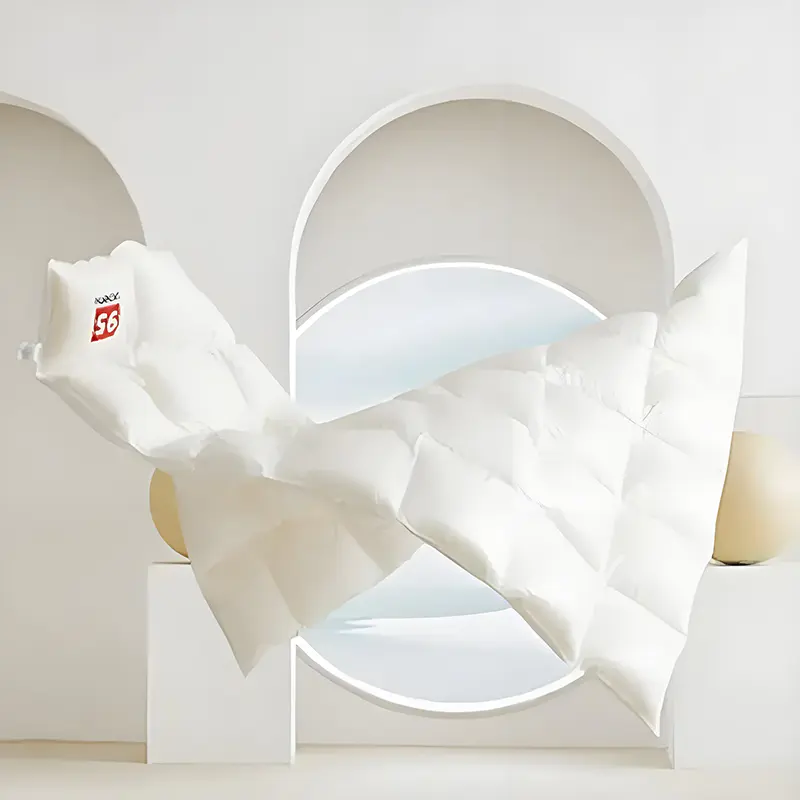
Goose Down vs. Duck Down vs. Eiderdown
The species and geography of the bird have a measurable effect on cluster size, loft resilience, and price. Understanding the hierarchy helps buyers match specification to budget.
| Fill Type | Typical Fill Power | Approx. Cost / kg (raw) | Key Characteristic |
|---|---|---|---|
| Duck down (standard) | 450 – 600 FP | USD 30 – 80 | Widely available; slight odour risk |
| Goose down (standard) | 600 – 750 FP | USD 80 – 180 | Larger clusters; lower odour |
| Hungarian / Polish goose | 750 – 850 FP | USD 180 – 350 | Cold-climate birds; premium loft |
| Eiderdown | 700 – 800 FP | USD 2,000 – 3,500+ | Hand-harvested; unique interlocking structure |
Eiderdown's extraordinary price is not primarily a function of fill power — premium Hungarian goose down actually lofts higher. The premium is driven by scarcity and harvesting method: eider ducks (Somateria mollissima) are protected species in Iceland and Scandinavia, and the down is hand-collected from abandoned nests after chicks fledge. Global annual production is estimated at under 3,000 kg, making it one of the rarest natural fibres traded. A finished double-size eiderdown quilt typically retails between USD 8,000 and USD 20,000, with bespoke Icelandic examples reaching higher.
Shell Construction and Baffle Design
The outer shell of a down quilt performs two functions: it contains the fill and it breathes, allowing moisture vapour to escape from the sleeping environment. Thread count and weave density are the key shell specifications. A downproof fabric typically requires a minimum of 230 thread count in a tight calendered weave, with a down-proof rating expressed as a pore size below 10 microns. Higher thread counts (400–500 TC) feel silkier but add weight and marginally reduce breathability.
Internal baffle construction determines how evenly down distributes and stays in place:
- Sewn-through (quilted) — simplest construction; top and bottom shells are stitched directly together in a grid or diamond pattern. Creates cold spots at the stitch lines; suitable for lighter summer quilts only.
- Box baffle — internal fabric walls create three-dimensional chambers allowing down to loft fully in all directions. The standard in mid-to-premium winter quilts.
- Slant baffle (trapezoid) — angled internal walls interlock adjacent chambers, reducing down migration between sections. Used in high-end quilts where consistent coverage across the entire surface is critical.
- Hungarian point (V-baffle) — complex sewn pattern that locks clusters in position; found almost exclusively in luxury European bedding.
Ethical Sourcing: RDS Certification and Responsible Down
Consumer and retail scrutiny of down sourcing has intensified. The two certification standards most widely recognised in the global market are the Responsible Down Standard (RDS), administered by Textile Exchange, and the Global Traceable Down Standard (Global TDS). Both prohibit live-plucking and force-feeding practices and require supply chain traceability from farm to finished product through third-party audits.
For B2B buyers supplying European retailers, RDS certification has moved from a premium differentiator to a baseline procurement requirement. Retailers including several major German and Scandinavian chains have mandated RDS as a condition of listing since 2022. Suppliers without certification are increasingly excluded from tender processes regardless of price competitiveness. Buyers sourcing at scale should verify that the certification covers the specific farm cluster supplying the batch — umbrella certifications that cover a processor but not upstream farms do not satisfy current retailer requirements.
Care, Longevity, and Restoring Loft
A quality down quilt maintained correctly will outlast multiple synthetic alternatives by a significant margin — lifespans of 15–25 years are realistic for quilts filled with 700 FP+ down in a box-baffle construction. The primary enemy is compressed, damp clusters that clump and lose their air-trapping structure.
Washing: use a front-loading machine at 30–40°C with a down-specific detergent free of optical brighteners or enzymes. Top-loaders with central agitators can stress baffles; avoid them. Rinse twice to remove all detergent residue — residue is the most common cause of persistent odour after washing.
Drying: tumble dry on low heat with two or three clean tennis balls or dryer balls. The balls break apart clumped wet clusters mechanically as they tumble. Expect a minimum of three to four drying cycles before the quilt reaches full loft; pulling it out of the dryer while the core is still damp and storing it compressed is the most common cause of mould and permanent loft loss.
Storage: store in a breathable cotton bag, never a compressed vacuum bag. Down clusters compressed for extended periods suffer permanent structural damage that no amount of fluffing will reverse. A cool, dry location away from direct sunlight preserves the shell fabric and prevents UV degradation of the cotton weave.
News Center
If you are interested in our products, please consult us
Contact Details
- Address : East 1st Floor, Building 3, No.3 Light Textile Road, Xucun Town, Haining City, Jiaxing City, Zhejiang Province
- Tel: +86-18133691685
- E-mail: [email protected]
Products
Quick Link
News Center
Mobile terminal

