

 English
 Español
 عربى
عربى
Home / News / Industry News / How Does Pure White Duck Down Compare to Goose Down in Warmth and Durability?

How Does Pure White Duck Down Compare to Goose Down in Warmth and Durability?
2026-01-14
In the global insulation materials market, natural down remains the gold standard for high-performance thermal products due to its exceptional warmth-to-weight ratio and compressibility. For B2B buyers in bedding and outerwear supply chains, understanding the differences between Pure White Duck Down and goose down is crucial. Pure White Duck Down insulation performance data indicates it is widely used in large-scale production due to availability, cost efficiency, and consistent performance. According to the 2025 Materials Market Report, global virgin down production grew by over 5% in one year, with ducks accounting for roughly 85–90% of total output.
Source: Textile Exchange Materials Market Report 2025
Content
Introduction to Natural Down Materials
Down consists of fine, fluffy clusters of feathers that trap air, providing thermal insulation. Pure White Duck Down is favored in industrial applications for its uniform quality and high availability. Goose down generally has larger clusters, offering greater loft and higher insulation per unit weight but at a higher cost. The fill power metric is essential for evaluating thermal efficiency in both materials.
Thermal Performance: Fill Power and Warmth
Fill power measures the volume in cubic inches per ounce that down occupies under controlled conditions, reflecting warmth-to-weight efficiency. Pure White Duck Down fill power comparison shows slightly lower loft than goose down, but still provides strong insulation for mid-range thermal applications.
| Property | Pure White Duck Down | Goose Down |
| Average Fill Power | 450–700 cu in/oz | 650–900+ cu in/oz |
| Thermal Insulation | Moderate to High | High to Very High |
| Warmth-to-Weight Ratio | Lower than Goose | Higher than Duck |
Recent industrial testing confirms that goose down provides superior loft and thermal retention per unit weight, making it ideal for extreme cold applications. However, Pure White Duck Down vs goose down durability analysis shows that duck down maintains competitive performance in standard winter conditions.
Source: JOC‑Fareast Down Comparison Data
Durability and Longevity in Industrial Usage
Durability is critical for B2B procurement as it affects product lifecycle and total cost of ownership. Duck down can withstand repeated compression, maintaining thermal properties for long-term use.
| Metric | Pure White Duck Down | Goose Down |
| Expected Lifespan (Years) | 8–10 | 10–15+ |
| Loft Retention | Good | Excellent |
| Moisture Resistance | Moderate | High |
Duck down’s denser fiber matrix offers moderate resistance to humidity, an important consideration for products distributed in humid regions. Proper grading and sorting enhance durability and insulation performance. Industrial standards for Pure White Duck Down quality ensure predictable performance for bulk manufacturing.
Source: Industry Analysis on Duck Down Performance
Quality Standards and Testing Methods
The 2025 Chinese national standard GB/T 45266‑2025 defines quality grading for down-filled consumer products. Standards cover cluster percentages, fill power, and purity to ensure consistency in industrial applications. Compliance with Best practices for Pure White Duck Down sourcing guarantees that thermal properties match the product specifications, enabling reliable mass production for bedding and outerwear.
Source: GB/T 45266‑2025 Standard
Practical Considerations for Large‑Scale Buyers
- Verify supplier compliance with both internal quality management systems and external certification protocols.
- Compare Pure White Duck Down fill power comparison reports and cluster grading to determine suitability for intended product lines.
- Balance cost versus performance, considering that goose down offers higher loft but higher procurement cost, while duck down provides competitive performance at scale.
- Ensure traceability from farm to finished product to maintain quality control.
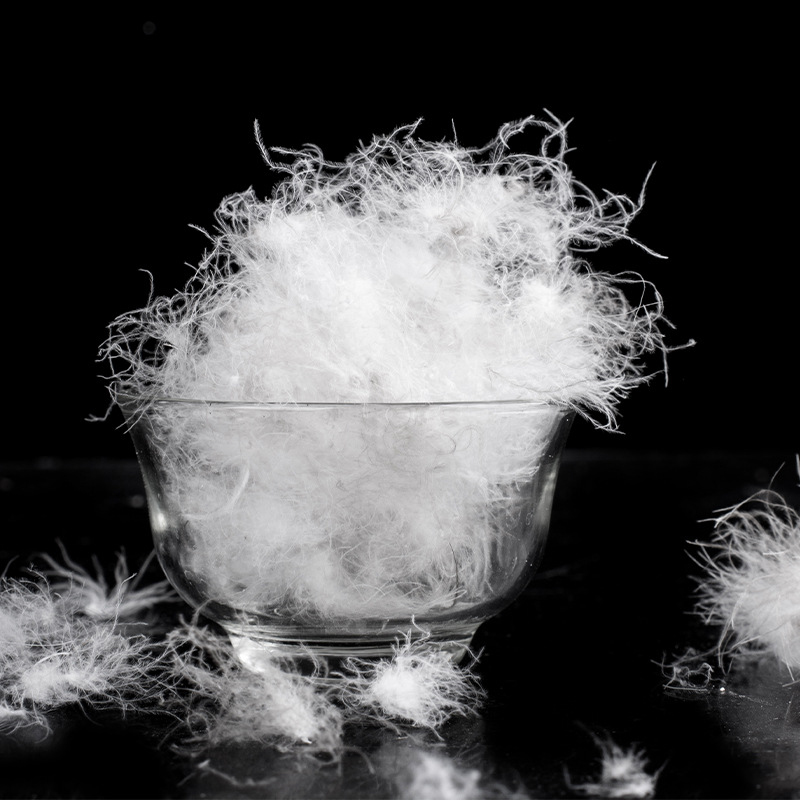
For industrial buyers, Pure White Duck Down offers an effective balance of thermal insulation, durability, and cost efficiency. While goose down delivers superior warmth per ounce, duck down’s wide availability, stable supply, and compliance with modern standards make it a practical choice for high-volume manufacturing. Leveraging updated industry standards and independent testing ensures reliable product performance.
Frequently Asked Questions (FAQ)
- Q1: What is the typical fill power range for Pure White Duck Down compared to goose down?
A1: Pure White Duck Down typically ranges from 450–700 cu in/oz, while goose down ranges from 650–900+ cu in/oz. Goose down has larger clusters, offering higher loft and thermal efficiency.
- Q2: How does humidity affect the thermal performance of duck down insulation?
A2: Duck down has moderate resistance to moisture due to its denser fiber structure, but prolonged exposure to high humidity may slightly reduce loft. Proper storage and processing maintain insulation properties.
- Q3: Which industry standards apply to high-grade down used in commercial bedding?
A3: Standards such as GB/T 45266‑2025 in China define cluster percentage, fill power, and purity requirements. Compliance ensures predictable thermal performance in industrial applications.
- Q4: Is there a measurable difference in longevity between duck and goose down products?
A4: Yes, goose down generally has a lifespan of 10–15+ years with excellent loft retention, while duck down lasts 8–10 years with good loft retention, making both suitable for mid- to long-term applications depending on product tier.
- Q5: How should buyers verify supplier test data for down cluster quality?
A5: Buyers should request independent lab reports and certifications, evaluate cluster percentages, fill power, and moisture resistance, and ensure suppliers adhere to relevant industrial standards for quality assurance.
News Center
If you are interested in our products, please consult us
Contact Details
- Address : East 1st Floor, Building 3, No.3 Light Textile Road, Xucun Town, Haining City, Jiaxing City, Zhejiang Province
- Tel: +86-18133691685
- E-mail: [email protected]
Products
Quick Link
News Center
Mobile terminal

