

 English
 Español
 عربى
Home / News / Industry News / Duck, Goose Down and Feather: What the Grades and Numbers Actually Mean

Duck, Goose Down and Feather: What the Grades and Numbers Actually Mean
2026-11-04
A 90/10 white duck down lot and a 90/10 white goose down lot can arrive with the same label, the same test certificate and a 150-point gap in fill power. At 180 g of fill per jacket, that gap decides whether the garment meets its warmth target or needs 240 g to get there. Composition, fill power and feather share are three separate numbers, and keeping them separate is what stops a purchase order from turning into a rework claim.
Content
- 1 Down and feather are two different materials, not two grades of one
- 2 Duck down and goose down differ mainly in cluster size and price
- 3 What the numbers on a down specification actually measure
- 4 Where feather content earns its place
- 5 Six checks that decide whether a lot matches its paperwork
- 6 Direct answers for buyers comparing grades
Down and feather are two different materials, not two grades of one
Down is the three-dimensional cluster that grows under a waterfowl's breast and belly; feather is the flat, quilled outer plumage, and the two behave differently in every test that matters for insulation. The cluster carries no quill, so it collapses to almost nothing under load and springs back; a feather has a stiff rachis and a two-dimensional vane, so it resists bending but traps little air for its weight.
Core definition
Down cluster: the quill-less, three-dimensional mass of barbs and barbules that traps air and gives down its loft. Feather: the outer plumage, built on a rigid quill with a flat vane, which supplies structure rather than insulation. Under EN 12934, the European standard for feather and down composition, the two are counted separately, and so is down fibre, the small barbed material that breaks away from clusters during washing and drying.
That separation explains why a blend sold as duck down feather can still be a sound insulator. In a 90/10 lot, 90% of the weight is clusters and 10% is feather; the clusters do the insulating, while the feather adds bulk, compression recovery and a lower cost per kilogram. Push the feather share to 30% and it starts to dominate the hand-feel, the weight and the drying behaviour of the finished product.
| Property | Down cluster | Feather |
| Structure | Quill-less, three-dimensional network of barbs | Rigid central quill with a flat, two-dimensional vane |
| Function on the bird | Insulation | Flight and weather shedding |
| Air trapped per gram | High, which is what fill power measures | Low; mass rises faster than loft |
| Recovery after load | Returns to shape | Bends and stays bent |
| Typical end use | Jackets, quilts, sleeping bags | Pillows, upholstery, cost-controlled blends |
Duck down and goose down differ mainly in cluster size and price
Goose down clusters are larger on average, which is why a 90/10 white goose down lot typically tests 700-800 fill power where an equivalent white duck down lot tests 600-700. Both are saleable, but they are not interchangeable gram for gram, and the price gap reflects cluster size rather than any hidden property of the bird.
700-800
cu in/oz, typical 90/10 white goose down
600-700
cu in/oz, typical 90/10 white duck down
1.0%
fat content ceiling in most washed-down contracts
Fill power is the number that drives warmth per gram. A jacket built around 700 cu in/oz fill needs roughly 15% less down by weight than the same jacket at 600 cu in/oz to hold the same thermal resistance, and the saving shows up in drape and pack size as well as in the invoice. The species trade-off, grade by grade, is set out in this comparison of goose down and duck down fill power.
Odour is a washing outcome, not a species trait. A duck down lot with fat residue under 1.0% and an oxygen number at or below 10 does not smell, while a poorly rinsed goose lot can. Buyers who reject duck down on smell are usually rejecting a rinsing process.
 90% Pure White Goose Down FillingReview the stated 90% goose down composition alongside measured fluffiness, oxygen consumption, turbidity and fat figures when comparing warmth and cleanliness claims.View Product →
What the numbers on a down specification actually measure
A 90/10 designation means 90% down clusters and 10% feather by weight under EN 12934, and it says nothing about loft, which is measured separately as fill power under EN 12130. Two lots can carry the same composition label and sit a full grade apart in fill power, so the composition figure alone will never work as a warmth specification.
EN 12934 also counts down fibre on its own line. Fibre adds weight without adding loft, so a report that folds it into the quoted down percentage is weaker evidence than one that lists clusters, fibre and feather separately. On the fill power side, the IDFB method and EN 12130 use different sample masses and cylinders, which means figures from two laboratories are only comparable when the method is printed next to the result.
Loft volume held by 1 kg of down at four fill power grades
Calculated from the fill power definition: cubic inches per ounce (28.35 g) converted to litres per kilogram.
| Label | Cluster share | Typical application | Fill power in trade |
| 90/10 | 90% | Down jackets, premium quilts, sleeping bags | 600-800 cu in/oz |
| 80/20 | 80% | Hotel quilts, mid-weight bedding, workwear | 500-650 cu in/oz |
| 70/30 | 70% | Cost-controlled quilts, pillows, liners | 450-550 cu in/oz |
| 50/50 | 50% | Pillows, upholstery, entry-level bedding | 350-450 cu in/oz |
Two lots can both read 90/10 and still differ by 150 fill power points. Composition tells you what is in the bag; fill power tells you what it does.
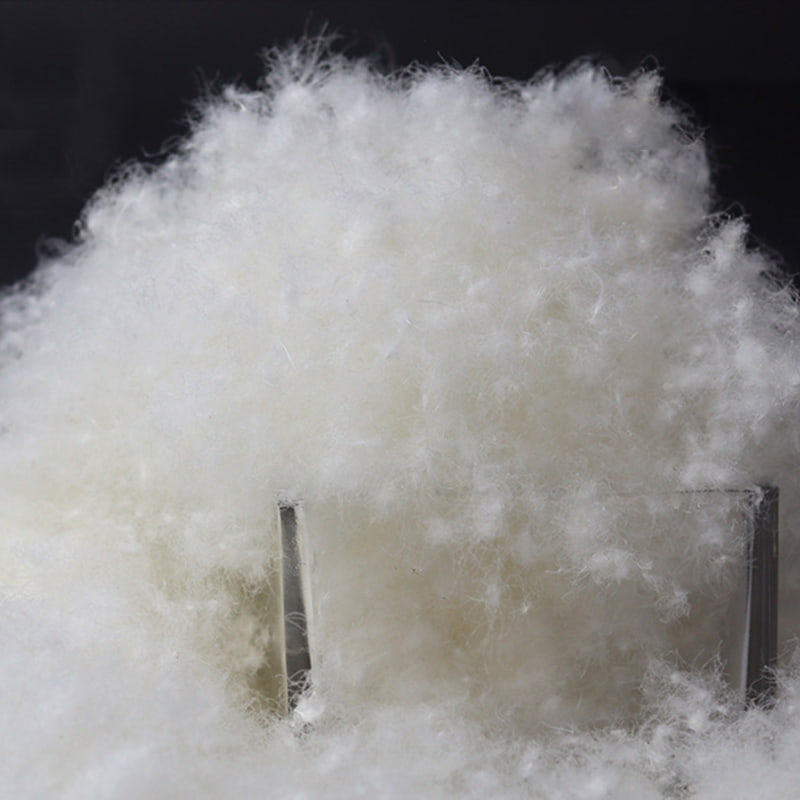 90% Pure White Duck Down FillingCheck the stated 90% duck down content, 16 cm fluffiness and the combined feather/fibre limit before comparing loft and warmth claims.View Product →
Where feather content earns its place
Feather is not automatically a defect: at 10-20% in quilt or pillow fill it adds resilience, speeds drying and lowers cost per kilogram, which is why hotel bedding often specifies 80/20 rather than 90/10. The decision is a durability decision, not a quality decision.
- It resists permanent compression in high-load positions such as pillows, mattress toppers and seat cushions.
- It dries faster than clusters after industrial laundering, which shortens tumble-dry cycles and reduces energy cost per wash.
- It lowers the fill cost per kilogram without forcing a change to the shell fabric or the baffle design.
- It adds weight, which is exactly why it is kept out of ultralight sleeping bags and expedition jacket baffles.
A 20% feather share buys compression recovery across repeated industrial laundering; a 90/10 fill trades that durability away for loft.
In a jacket baffle, the same 10% feather share adds grams without adding warmth, and in a sleeping bag it adds pack volume the customer will notice. Match the composition to the wash cycle and the load the fill will carry, and the grade choice stops being a matter of taste.
 All-Season Hotel Down Quilt FillingA duck and goose down filling for hotel quilts, with stated high-temperature drying care and year-round use for cost-conscious bedding programs.View Product →
Six checks that decide whether a lot matches its paperwork
Six documents and bench results decide whether a down lot matches its paperwork: composition, fill power, oxygen number, turbidity, fat content and species traceability. Any one of them missing turns the rest into an assumption.
- Composition report under EN 12934, with down clusters, down fibre and feather listed on three separate lines.
- Fill power under EN 12130 or the IDFB method, with sample mass and method printed beside the figure.
- Oxygen number under EN 1162, against a typical contract ceiling of 10.
- Turbidity under EN 1164, against a typical minimum of 100 mm for washed down.
- Fat content under EN 1163, against a typical ceiling of 1.0%; this is the figure that predicts odour after a wash.
- Traceability through a Responsible Down Standard (RDS) scope certificate plus a transaction certificate naming the lot, with species and colour matching the label.
Zhejiang Shengjie Down Products Co., Ltd. has produced white duck down, white goose down and grey grades in Haining, Zhejiang for more than 20 years, and keeps its certification and honour records in separate site sections. Buyers who want to pre-qualify a grade before requesting samples can review the company's published answers to common down purchasing questions.
Direct answers for buyers comparing grades
Is goose down always warmer than duck down?
No. Warmth follows fill power and fill weight, not species: a 700 cu in/oz white duck down lot outperforms a 600 cu in/oz white goose down lot at equal weight. Compare the two at the same fill power before paying the goose premium.
Does a 90/10 label guarantee no feathers?
No. Under EN 12934 a 90/10 label permits 10% feather by weight, so a 1,000 kg lot can carry up to 100 kg of feather. A zero-feather claim needs a 100% cluster specification and a laboratory report showing feather at or below the reporting threshold.
What fill power does a winter jacket need?
650-750 cu in/oz covers most urban and three-season winter jackets at 120-180 g of fill, while expedition pieces use 800 cu in/oz and above. Below 550 cu in/oz the fill weight has to rise by roughly a third to hold the same warmth, which changes bulk and pack size.
Can you tell duck from goose down in a finished product?
Not reliably by hand. Species identification is done in a laboratory on cleaned samples, so the audit trail is the label plus the EN 12934 report and the RDS transaction certificate for the lot. A supplier who offers to sort species by feel is describing a guess, not a test.
News Center
If you are interested in our products, please consult us
Contact Details
- Address : East 1st Floor, Building 3, No.3 Light Textile Road, Xucun Town, Haining City, Jiaxing City, Zhejiang Province
- Tel: +86-18133691685
- E-mail: [email protected]
Products
Quick Link
News Center
Mobile terminal

