

 English
 Español
 عربى
Home / News / Industry News / Fill power 700 duck equals goose: Applications, Selection Criteria, and Practical Guidance

Fill power 700 duck equals goose: Applications, Selection Criteria, and Practical Guidance
2026-11-18
A buyer comparing 700 fill power white duck down with 700 fill power white goose down is comparing two samples that loft to the same height: one ounce of either settles at 700 cubic inches, holds the same air, and keeps a wearer equally warm in the same shell. Species does not enter that calculation. What does differ, and what actually decides the purchase order, is how each fill behaves after twenty washes, how it smells after a season in a humid warehouse, and what the test report and the invoice say about it.
Content
- 1 At Equal Fill Power, Duck and Goose Insulate Identically
- 2 What the Fill Power Test Measures, and What It Ignores
- 3 Where 700 Duck and 700 Goose Genuinely Differ
- 4 Reading a 700 Claim on a Test Report
- 5 Writing a 700 Fill Power Order That Survives Production
- 6 Matching 700 Loft to the End Product
- 7 Decisions the Loft Number Does Not Make for You
At Equal Fill Power, Duck and Goose Insulate Identically
A 700 fill power duck down and a 700 fill power goose down insulate the same, because down traps heat with air volume, and one ounce of either fill lofts to 700 cubic inches under the same test.
Down is a fixed-volume insulator: clusters hold still air, still air slows heat loss, and equal volume per ounce means equal air. Once the loft number matches, any remaining warmth difference comes from fill weight, baffle height, shell fabric and moisture, none of which a species label describes.
700Cubic inches per ounce, IDFB 10-B
90%Down content normally needed to hold 700
5Point increments used in lab reporting
Fill power is the settled volume of one ounce of down, expressed in cubic inches, after the sample is lofted in a calibrated cylinder under a specified load, tested to IDFB 10-B or EN 12130 and reported in 5-point increments.
Nothing in that definition depends on species. Laboratories record species, colour and origin on the report because buyers ask for them, not because the figure changes. A duck lot at 700 and a goose lot at 700 enter a specification with the same value and, inside the same shell, deliver the same thermal result.
What the Fill Power Test Measures, and What It Ignores
The fill power test is a geometry measurement: it records the volume the clusters occupy after lofting and says nothing about wash durability, odour, or how the fill behaves after a year inside a quilt.
The sample is conditioned to controlled temperature and humidity, dropped into a calibrated cylinder, and settled by a weighted piston. The operator reads the settled volume, repeats the run, and the laboratory averages the readings. A well-processed duck lot and a well-processed goose lot can land on the same number and be genuinely interchangeable in the finished product.
Why the Method Name Matters More Than the Number
IDFB 10-B and EN 12130 do not return the same figure from the same bag. European readings sit lower, and a sample reported at 700 on the IDFB method usually lands between 600 and 640 on EN 12130. A specification that says 700 fill power without naming the method is ambiguous by default, and a supplier quoting the European figure against an American-method order will look short on arrival even when the down itself is correct.
What It Takes for Duck Down to Reach 700
Loft at this level needs large, mature clusters and high down content, normally 90% down to 10% feather, plus washing and drying that neither strips the natural oil from the clusters nor mats them. White duck down from mature birds reaches 700 in normal production, so the constraint is grading and process discipline rather than species.
Method gap
Same bag, two numbers: 700 fill power on IDFB 10-B is typically 600 to 640 on EN 12130.
Where 700 Duck and 700 Goose Genuinely Differ
Both fills insulate the same in the first season; they separate over time, because goose clusters are larger and recover loft after compression and washing more consistently, while duck clusters are smaller and carry a higher odour risk when fat removal is incomplete.
700 white duck
- Loft of 700 is routine at 90% down content in mature white duck
- Smaller average cluster, so loft drops faster under repeated hot washing and compressed storage
- Higher residual odour risk if the wash and rinse stages are rushed
- Lower cost per kilogram and steadier availability across seasons
700 white goose
- Same 700 loft, delivered by larger clusters with thicker walls
- Holds loft through more wash and dry cycles, which matters in hotel and rental programmes
- Lower odour risk at equal processing quality
- Higher price per kilogram and tighter supply of consistent 700-plus lots
The price gap is not a warmth gap. It buys cluster size, wash durability and the marketing weight of the word goose. For a jacket laundered twice a season the durability argument is minor; for a hotel quilt pushed through a commercial laundry at 70 to 80 degrees Celsius every few weeks, it decides the specification.
The site's own comparison of goose down and duck down covers feather ratios and blend behaviour in more depth if the decision turns on species rather than loft.
Reading a 700 Claim on a Test Report
A 700 claim is only as strong as the report behind it: an accredited laboratory, the method printed on the page, a sample dated within the previous 12 months, and a stated tolerance of about 5% between the lab sample and the bulk.
Settled loft in cubic inches per ounce, bars scaled from 600 to 750. Illustrative lot readings at 90% down content.
Fill power is a distribution rather than a constant. Cluster mix shifts with bird age, season and origin, and two lots cut from one purchase can sit 20 points apart with nothing defective in either. Buyers who specify 700 minimum with a 5% tolerance raise fewer claims than buyers who specify 700 exact, because the second version asks a natural material to repeat a laboratory value at container scale.
Two lots of the same species routinely differ more than two lots of different species. The test report, not the label, decides the shipment.
Writing a 700 Fill Power Order That Survives Production
A purchase order that fixes six parameters, namely fill power and method, down content, species and colour, oxygen number, turbidity and moisture, removes most of the arguments that follow delivery.
| Parameter | Target for a 700 programme | Why it sits on the order |
| Fill power | 700 minimum, IDFB 10-B, 5-point reporting | The only figure that predicts loft per ounce |
| Down content | 90% down, 10% feather maximum | Below 90% the loft usually falls to the 600 to 660 band |
| Oxygen number | 10 mg per 100 g maximum | Flags under-washed fill and the odour risk that follows |
| Turbidity | 500 mm minimum | Measures how clean the fill reads in the finished product |
| Moisture content | 13% maximum | Wet fill loses loft and develops odour in storage |
| Species and colour | Declared and verified on the report | Labelling compliance under EN 12934 and GB/T 17685 |
Zhejiang Shengjie Down Products Co., Ltd., which produces in Haining, Zhejiang, grades both species by down content and supplies raw fill alongside finished filling programmes, so a 700 loft target can be quoted in white duck or white goose without changing supplier. Its duck down grades run from 50% to 90% down content, and the 90% grades are the ones quoted against 700 loft work.
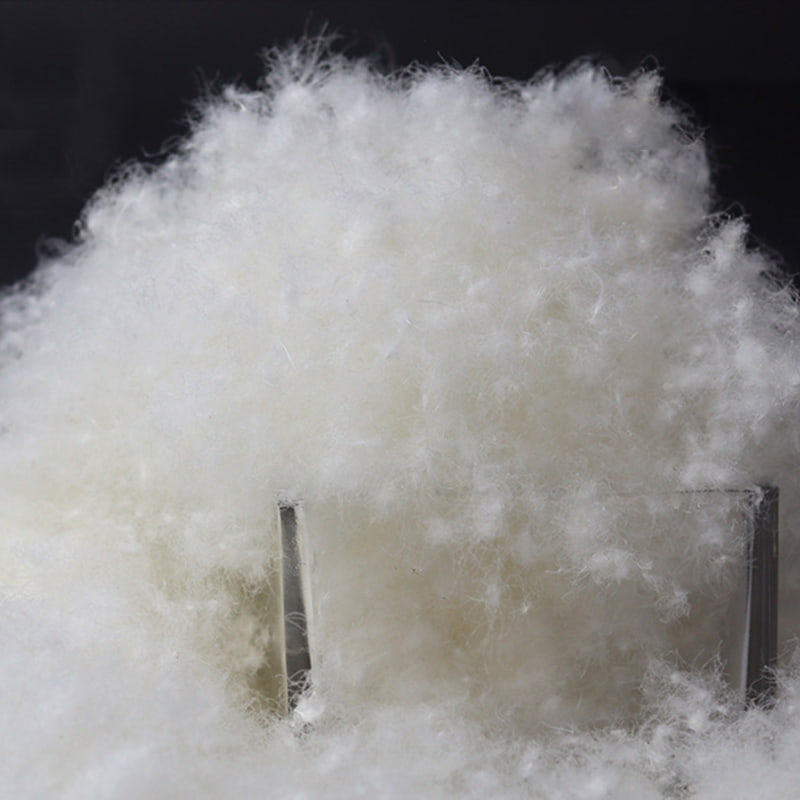 90% Pure White Duck Down FillingA 90% white duck down fill graded for 700 loft work, with clustered structure, warmth and moisture handling for woven down clothing.View Product →
 90% Pure White Goose Down FillingHigh-end goose down with 17 cm loft, positioned for woven down clothing and offering temperature-regulating, heat-locking structure for premium fills.View Product →
Matching 700 Loft to the End Product
Loft at 700 buys weight savings: roughly 120 to 150 g of 700 fill power down fills the same height as 155 to 190 g of 550 fill power down, because loft per ounce rises about 27% across that range.
The arithmetic is simple. The same baffle needs about 21% less fill weight at 700 to reach the volume that 550 delivers, which is why the grade appears in ultralight jackets and hotel quilts rather than in budget bedding.
- Outerwear: baffle height and stitch-through construction cap performance before fill power does, and above 650 the build matters more than the grade
- Hotel quilts: repeated washing at 70 to 80 degrees Celsius decides the grade, and goose at 700 usually outlasts duck at 700 on this measure
- Sleeping bags: re-loft after compression and moisture behaviour beat the last 30 points of fill power
- Pillows: resilience and support matter more than loft, so 700 is rarely the right target
 Three-Dimensional Duck Down Outdoor Jacket FillingAt equal loft, this duck down fill offers breathable warmth and durable performance for outdoor jackets.View Product →
Decisions the Loft Number Does Not Make for You
Is 700 fill power duck as warm as 700 fill power goose?
Yes. At equal fill weight and equal baffle construction, both fills loft to 700 cubic inches per ounce and hold the same air volume, so thermal performance matches within the 5% tolerance of the test.
Why does goose cost more when the loft is identical?
Because the difference sits in cluster size and durability rather than warmth. Larger goose clusters recover loft through more wash cycles and carry lower odour risk, and the word goose carries retail value; the premium reflects those three factors, not a temperature rating.
Can 80% duck down reach 700 fill power?
Rarely. Loft at that level normally requires 90% down content, while 80% white duck typically tests between 600 and 660 on the IDFB method. A supplier offering 700 at 80% content should provide the lot report before the order is placed.
Which numbers belong on the purchase order?
Write 700 fill power minimum, IDFB 10-B, 5% tolerance at shipment, with down content at 90% or higher, oxygen number at 10 mg per 100 g or lower, turbidity at 500 mm or higher and moisture at 13% or lower. A loft figure without the method beside it is the most common reason a shipment is rejected.
News Center
If you are interested in our products, please consult us
Contact Details
- Address : East 1st Floor, Building 3, No.3 Light Textile Road, Xucun Town, Haining City, Jiaxing City, Zhejiang Province
- Tel: +86-18133691685
- E-mail: [email protected]
Products
Quick Link
News Center
Mobile terminal

