

 English
 Español
 عربى
Home / News / Industry News / Down Cluster 90% vs Feather Content: What the Last 10% Really Adds to Fill

Down Cluster 90% vs Feather Content: What the Last 10% Really Adds to Fill
2026-11-11
Two spec sheets land on the same buyer's desk. The first reads "90% white goose down, 750 fill power". The second reads "90% down, 10% feather". Both statements are accurate, both describe the same ratio, and the jackets built from them can still differ by 100 cuin or more of measured loft once the fill is blown into baffles.
That gap is why the comparison is worth doing properly. Down cluster 90% versus feather content is not a contest between two materials. It is a question about what occupies the last 10% of a fill's weight, and whether that 10% is doing useful work or simply adding mass to a garment that will be sold as premium.
A 90/10 fill is the working standard for premium outerwear and four-season duvets. It is also the grade most often described loosely in quotations, because cluster content and feather content are measured by different methods and reported against different standards.
90%Cluster content by weight
10%Feather plus down fibre
700-850Typical cuin, 90/10 white goose
+/-2 ppCommon contract tolerance
Definition
Down cluster content is the percentage of a fill's total weight made up of down clusters: three-dimensional, quill-free tufts that trap air and recover their shape after compression. Feather content is the balance, counted as flat feathers with a central quill, plus down fibre, the small barbed filaments that add weight but almost no loft.
Content
- 1 What a 90% Down Cluster Claim Actually Means
- 2 Why Clusters and Feathers Behave Differently Inside a Baffle
- 3 Where the 10% Sits: Down Fibre, Feather and Quill
- 4 What the Last 10% Costs, and Why the Contract Needs a Tolerance
- 5 How to Verify a 90/10 Claim Before You Sign
- 6 Matching 90/10 to Jackets, Duvets and Sleeping Bags
What a 90% Down Cluster Claim Actually Means
A 90% down cluster declaration means clusters make up at least 90% of the fill's weight, and the remaining 10% is split between down fibre and feather. That split is rarely printed on the quotation, and it changes performance more than the headline figure suggests.
Two standards do most of the work here. EN 12934, the European designation standard for processed feathers and down, reports down and feather as separate whole percentages of the mix. GB/T 17685, China's national down and feather standard, reports cluster content separately from down fibre, so a fill that passes at 90% under one framework is not automatically at 90% under the other. When a supplier quotes a number, ask which method produced it and which laboratory signed the report.
- Cluster size distribution: a 90/10 built from large, mature clusters lofts measurably higher than a 90/10 built from small clusters and reclaimed fibre.
- Species and colour: white goose, white duck and grey duck at identical cluster content sit in different fill power bands and different price bands.
- Residual fibre: fibre is counted inside the 10% on some certificates and pushed onto a separate line on others, so two documents both labelled 90/10 can describe two different fills.
Cluster content is a weight ratio. Warmth is a volume property. The two move together, but they are not the same number, and a specification sheet that gives only one of them is giving you half a picture.
Why Clusters and Feathers Behave Differently Inside a Baffle
A down cluster holds roughly its own volume in air and springs back after load; a feather has a rigid quill and flat vanes that bend and stay bent. That single structural difference is why 90/10 and 80/20 fills of the same species separate so clearly in a compression test, even when both sit inside a normal specification window.
Typical fill power by cluster content, white goose down, cuin
90/10750
80/20670
70/30590
50/50480
At 40 g of fill in a jacket baffle, a 70 cuin difference is roughly one full size of thermal comfort. Buyers who move from 80/20 to 90/10 typically hold the same warmth target while reducing fill weight by around 10%, which also trims the shell and shipping cost.
Down cluster
- No quill, so it compresses into a small pack size
- Recovers most of its loft after repeated compression
- Loft is measured in cuin under the EN 12130 method
- Cost per kilogram climbs steeply above 85%
Feather
- Central quill adds mass without adding loft
- Stays flattened after load, so recovery drops
- Counted as a separate percentage under EN 12934
- Cheap per kilogram, which is exactly the sourcing risk
Where the 10% Sits: Down Fibre, Feather and Quill
In a cleanly sorted 90/10 fill, the non-cluster fraction is dominated by down fibre with a small feather share; in a cheaper version the feather share climbs and the fill gets heavier at the same warmth. The table below shows what normally sits behind four common declarations.
| Declared ratio | Cluster / non-cluster | Typical fill power | Best-fit products |
| 90/10 | 88-92% / 8-12% | 700-850 cuin, white goose | Premium jackets, four-season duvets |
| 80/20 | 78-82% / 18-22% | 620-720 cuin | Mid-weight outerwear, hotel duvets |
| 70/30 | 68-72% / 28-32% | 560-640 cuin | Economy duvets, sleeping bags |
| 50/50 | 48-52% / 48-52% | 450-550 cuin | Budget insulation, cushion fill |
Zhejiang Shengjie Down Products Co., Ltd., a down producer based in Haining, Zhejiang with more than 20 years in the trade, grades its goose and duck lines at 50%, 80% and 90% cluster content, which maps closely onto the four bands above. For buyers working at the top of that ladder, the 90% pure white goose down line is the reference grade against which the rest of the matrix is priced.
 90% Pure White Goose Down FillingA high-grade filling for woven down garments and the 90% reference grade for buyers comparing the producer's 50%, 80% and 90% lines.View Product →
Feather is not automatically a defect. In pillows and lower-cost duvets a controlled feather share adds support and reduces settling, which is why some specifications ask for it by name. The problem only appears when feather occupies the non-cluster fraction without being declared, because a quill changes hand feel long before it changes a test certificate.
What the Last 10% Costs, and Why the Contract Needs a Tolerance
Moving from 80/20 to 90/10 is the most expensive step on the entire grade ladder, because it demands more raw material per kilogram of finished fill and more sorting time on the line. On an illustrative index where 90/10 white goose sits at 100, 80/20 lands near 85 and 50/50 near 55; the exact spread shifts with season and with the feather market, but the shape of the curve holds.
That price gap is why tolerances matter more than they look. A plus or minus 2 percentage point band on cluster content is normal in business-to-business contracts, and a lot that tests at 88% can still be delivered in good faith as 90/10. What is not acceptable is an undeclared feather share inside the non-cluster fraction.
A 90/10 lot that tests at 88% cluster content still conforms under a two-point band. A lot that hides its feather share inside the 10% does not, whatever the headline figure says.
Colour is the other lever on cost. Where the shell is opaque or dark, a 90% white duck down fill removes the premium paid for whiteness without touching cluster content, and the difference shows up in hand feel only through cluster size, not through the label. Suppliers that sort by species and colour as separate inventory lines can quote both options from the same production floor.
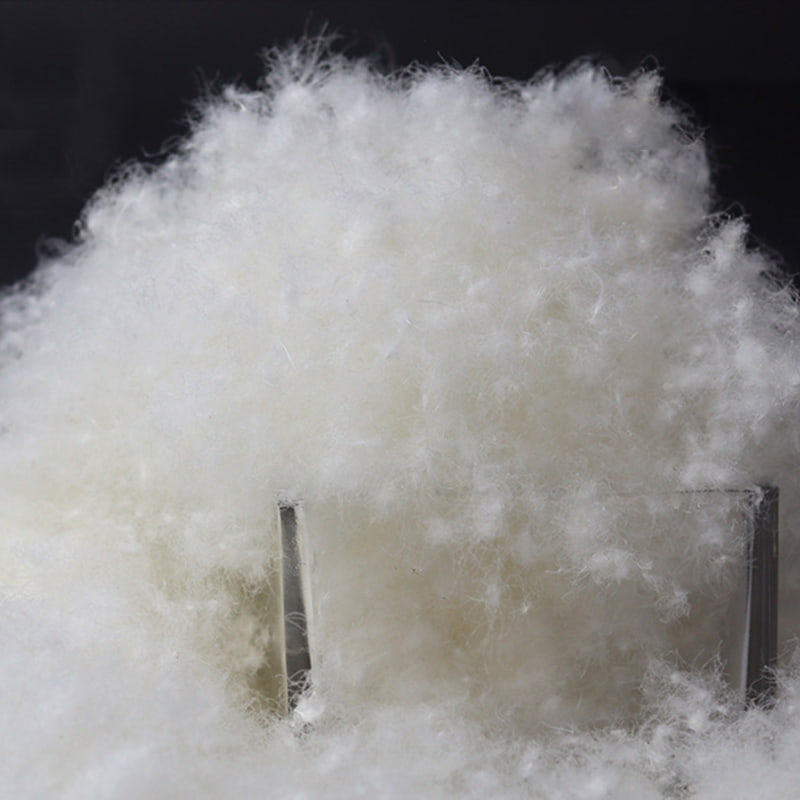 90% Pure White Duck Down FillingWhite duck down filling for woven down clothing, useful where an opaque shell makes colour less visible while retaining 90% cluster content.View Product →
For a closer look at how feather content changes the feel of a finished duvet rather than a raw sample, this comparison of down versus feather fill in finished comforters walks through the same ratio from the consumer side.
How to Verify a 90/10 Claim Before You Sign
Third-party composition testing settles a 90/10 claim in about five working days and costs less than a single production run, which makes verification the cheapest risk control in the whole purchase. Build it into the order, not into the dispute.
Verification sequence
- Ask for the test report and the method behind it: EN 12934 for composition, EN 12130 for fill power, GB/T 17685 for cluster content.
- Request a sealed 30 g sample drawn from the bale, not from the laboratory bag the supplier keeps on file.
- Book an independent laboratory such as the International Down and Feather Testing Laboratory (IDFL) to re-test cluster, feather and fibre as separate figures.
- Write the tolerance into the purchase order, typically plus or minus 2 percentage points on cluster content with a hard ceiling on feather.
- Repeat the test at every seasonal lot change, because raw material sourcing shifts between seasons and a passing lot from March says little about June.
Colour and species grading sit outside the composition test, so a 90% grey duck down lot can pass every cluster check while still being the wrong grade for a white-shelled premium jacket. Where the shell hides the fill, grey duck at 90% cluster content delivers the same thermal profile at a lower landed cost, and the verification work is identical.
 90% Grey Duck Down FillingGrey duck down filling for woven down garments, suited to hidden-fill styles where 90% cluster content meets the same thermal grade at lower colour premium.View Product →
Buyers who need the paperwork trail in one place can start with the down sourcing questions collected by the mill, which cover sampling, certificates and lot traceability.
Matching 90/10 to Jackets, Duvets and Sleeping Bags
The right cluster content is set by the product's cleaning cycle and its warmth target, not by the highest number on the price list. A duvet washed at 60 C twice a month behaves very differently from a jacket washed once a season.
- Outerwear: 90/10 in the 700-850 cuin band at 120-180 g/m2 fill weight covers typical winter city and alpine layering specifications.
- Hotel and institutional duvets: 80/20 or 90/10 with high-temperature drying tolerance wins on cost per wash cycle rather than on fill power alone.
- Home winter duvets: 90/10 at 300-400 g/m2 total fill gives warmth without the weight penalty of a 70/30 build.
- Sleeping bags: 90/10 keeps pack volume down, and below 700 cuin the volume penalty becomes obvious in a 0 C bag.
In every one of those cases the deciding figure is the cluster content at the tested weight, checked against the fill power the design actually needs. Feather content is the correction term that tells you whether the headline number is honest.
Is 90% down cluster warm enough for winter outerwear?
Yes. A 90/10 white goose fill in the 700-850 cuin band, used at 120-180 g/m2 in a baffled shell, covers typical winter outerwear targets. Below about minus 15 C, add fill weight rather than chasing a higher cluster percentage, because gram weight buys more warmth per unit of cost than the final two points of cluster content.
Does feather content make down feel prickly through the shell?
Only above a certain quill size. Feather sitting inside a 10% non-cluster fraction usually falls at the small end and stays imperceptible behind a 20D or heavier shell. For infant bedding and next-to-skin products, cap the feather share at 2-3% and require the fibre line to appear separately on the test report.
Is 90/10 goose down better than 90/10 duck down?
At equal cluster content, goose clusters are larger and typically reach 700-850 cuin against 600-750 cuin for duck, and goose fill holds loft slightly longer across wash cycles. Duck at 90/10 remains the better value wherever the shell is thick enough to hide the difference in hand feel.
Which test settles a dispute over a 90/10 delivery?
A sealed-sample composition test to EN 12934 or GB/T 17685, run by an accredited laboratory on a 30 g draw taken from the delivered bale. A result within plus or minus 2 percentage points of the declared cluster figure is normally accepted as conforming; anything outside that band is a contract issue rather than a matter of opinion.
News Center
If you are interested in our products, please consult us
Contact Details
- Address : East 1st Floor, Building 3, No.3 Light Textile Road, Xucun Town, Haining City, Jiaxing City, Zhejiang Province
- Tel: +86-18133691685
- E-mail: [email protected]
Products
Quick Link
News Center
Mobile terminal

