

 English
 Español
 عربى
عربى
Home / News / Industry News / How Is Down Feathers Collected: Methods, Grading, and Sourcing Standards

How Is Down Feathers Collected: Methods, Grading, and Sourcing Standards
2026-09-17
How down feathers are collected is a question best answered with arithmetic: a single mature goose yields only about 100 to 120 grams of usable down, so a winter jacket holding 250 grams of 90 percent white goose down represents the raw harvest of two to three birds, before washing and sorting shrink the volume further.
That ratio explains why the collection stage deserves attention from anyone buying filling material. The method used, the age of the bird, and the processing chain that follows all decide welfare risk, fill power consistency, price, and the documents a supplier can legitimately show you. This guide breaks down the three collection routes used worldwide, the washing and grading steps after collection, and the certification paperwork a B2B buyer should demand before signing a supply contract.
Definition: what down actually is
Down is the soft, quill-free undercoating that grows beneath the outer feathers of ducks and geese, concentrated on the chest, lower belly, and flanks. Each cluster is a three-dimensional tangle of fine filaments, so it traps far more air than flat-shafted feathers, which is why down, not feather, defines the insulation value of jackets, quilts, and sleeping bags.
Content
- 1 How Down Feathers Are Collected: The Three Routes That Supply the Market
- 2 After Down Feathers Are Collected: Washing, Sorting, and the 50/80/90 Grading System
- 3 Where Down Is Collected: Geography, Bird Maturity, and Market Size
- 4 Collection Standards: How Buyers Verify Ethical Down
- 5 A Five-Step Buying Checklist for Collected Down Lots
- 6 Frequently Asked Questions About Down Collection
How Down Feathers Are Collected: The Three Routes That Supply the Market
Down reaches the market through three routes: post-mortem harvesting after birds are slaughtered for meat, gathering of naturally molted down from live flocks, and live plucking, which every major certification standard now prohibits.
The overwhelming majority of commercial down is a by-product of the poultry and meat industries. As the Down Council of Canada notes, birds are not raised for their down; the material is recovered after slaughter, usually on automated plucking lines. Timing follows the meat calendar: most meat geese are slaughtered around 15 weeks after hatching, and the valuable clusters sit on the chest, lower belly, and flanks, the areas the wings do not cover.
Gathering is the second route. During the natural molt, waterfowl shed part of their down, and workers collect it from bedding, nests, and housing areas. Volumes per bird are small, so gathered down is rare and expensive; Icelandic eiderdown, hand-collected from abandoned nests, is the extreme example.
Live plucking is the third route and the central welfare controversy. Welfare investigations document feathers being pulled from restrained live birds in repeated cycles of up to four times per year, and reference works such as Wikipedia note that a portion of world supply still comes from live birds. Every standard listed later in this article excludes live-plucked material from certified lots.
| Collection method | How it works | Share of world supply | Standard status |
| Post-mortem harvesting | Down removed after slaughter for meat, usually by automated plucking lines | The clear majority of global volume | Accepted by RDS, GTDS, Downpass, and IDS when traceable |
| Gathering molted down | Down shed during the natural molt, collected from bedding and nesting areas | Small volumes, premium niches | Highest-welfare route; eiderdown is the best-known case |
| Live plucking | Feathers pulled from restrained live birds, historically up to four cycles per year | A small fraction, uncertified channels | Banned by all major standards; condemned by welfare groups |
Key fact
Because most geese are slaughtered at about 15 weeks of age, budget-grade down often comes from young birds whose clusters never reached full size, one reason 50 percent lots cost a fraction of mature-bird material.
After Down Feathers Are Collected: Washing, Sorting, and the 50/80/90 Grading System
Once raw down feathers are collected, they are washed in several cycles, heat-sterilized, dried, and machine-sorted so down clusters can be separated from quills and small feathers and blended into standardized lots.
Fresh plumage arrives mixed with dust, skin residue, and quill shafts. Processors run it through four to five wash cycles, sterilize the batch at high temperature, and dry it before mechanical sorting. Sorting machines classify clusters by size and weight, and the final label describes a weight ratio: in a 90 percent lot, at least 90 percent of the content is down cluster, with small feathers making up the difference. That ratio drives loft, warmth-to-weight, compressibility, and price.
Typical fill power by down content grade
50 percent
approx. 450
80 percent
approx. 600
90 percent
approx. 750
Indicative loft in cubic inches per ounce after standard conditioning; exact values vary by species and batch.
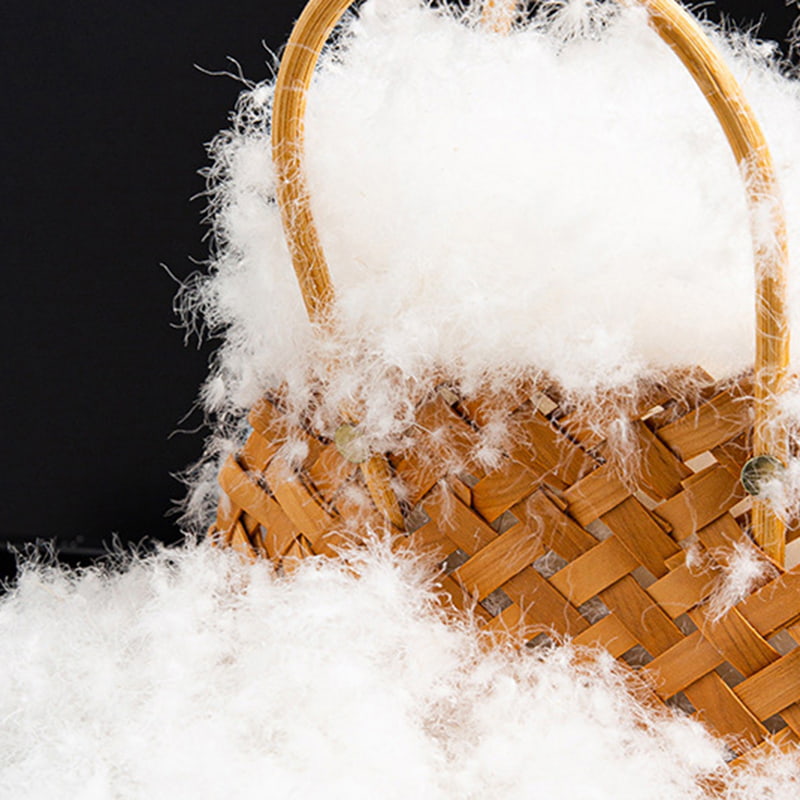 90% White Goose DownOriginated from the core down-producing areas of the abdomen, neck and wings of selected white geese, the natural down has a delicate reed-like clustered structure, fo...View Product →
 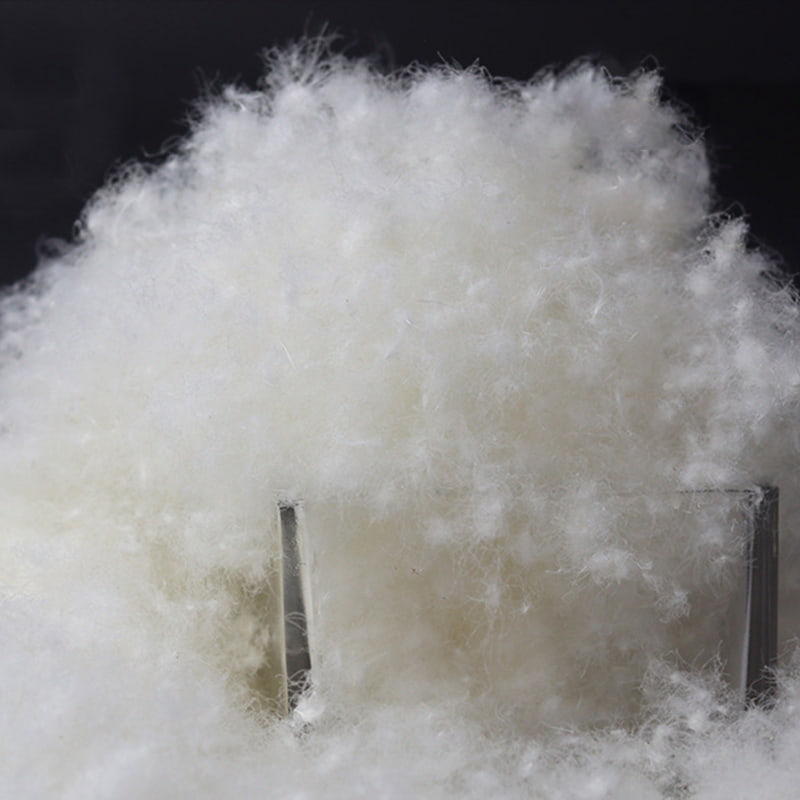 90% Pure White Duck DownOriginated from the duck's abdomen, neck, wings and other high-quality down-producing parts, the down presents a natural reed-like clustered shape with excellent fluff...View Product →
Buyers should read fill power and down content as a pair, because a high percentage grade with poor loft signals damaged or immature clusters. The companion guide on fill power, down content, and RDS certification explains how laboratories condition and test samples before a grade is confirmed.
Where Down Is Collected: Geography, Bird Maturity, and Market Size
Most of the world's down is collected in Asia, and clusters from mature, slow-finished birds consistently grade higher than material pulled from young meat birds.
Industry estimates place roughly 80 percent of global down supply in Asian processing hubs, with China as the largest producer and Hungary and Poland recognized for goose material. Maturity matters as much as geography: a two-year-old breeder goose produces noticeably larger clusters than a 15-week meat bird, and buyers pay measurable premiums for that difference.
$5 billionGlobal down market value in 2020
$7.5 billionProjected market size by 2027
approx. 80%Share of supply collected across Asia
Maturity beats geography. Down from an older breeder bird can outperform young-bird material from any famous region, which is why lot-level traceability tells you more than the country printed on the bag.
Collection Standards: How Buyers Verify Ethical Down
Certification frameworks exist to verify that down was collected as a slaughter by-product or gathered during molt, never pulled from live birds.
- Responsible Down Standard (RDS): third-party farm-to-factory audits that ban live plucking and force feeding.
- Global Traceable Down Standard (GTDS): documentation that follows each lot back to its parent farms.
- Downpass: a German standard built on independent audits and a complete chain of custody.
- International Down Standard (IDS): farm-level welfare scoring combined with full traceability.
Signals of a compliant supplier
- Batch test reports tied to lot numbers
- Farm-level traceability documents
- Current, numbered scope certificates
- Openness to third-party re-testing
Red flags during sourcing
- Prices far below the 90 percent market level
- Refusal to name parent farms
- Mixed lots without lot codes
- Certification claims without certificate numbers
Auditors verify these systems on-site, and procurement teams can review how responsibly sourced down is verified before deciding which standard to write into a contract.
A Five-Step Buying Checklist for Collected Down Lots
A disciplined purchase process converts collection and grading data into negotiating power: define the grade, verify traceability, test the batch, inspect the sample, and write the specifications into the contract.
- Define the end application first: 50 percent grades suit value lines, 80 percent suits mainstream jackets and quilts, and 90 percent belongs in premium bedding and outdoor gear.
- Request collection and traceability documents tied to the exact lot number you are buying.
- Require third-party test reports covering down content, fill power, turbidity, oxygen number, and odor.
- Inspect a physical sample: check loft recovery after compression, color consistency, and the absence of visible quill shafts.
- Fix specifications, tolerances, and re-test rights in the purchase contract before releasing any deposit.
 High Down Content, Zero Pressure, Zero Odor, Antibacterial And Anti-Mite, Thick Winter DuvThe natural down flowers from the core down-producing areas of the abdomen, neck and wings of white ducks are carefully selected. They present a unique three-dimension...View Product →
Suppliers with long processing histories build their export business on exactly this chain of evidence. Zhejiang Shengjie Down Products Co., Ltd., a down manufacturer in Haining, Zhejiang with more than 20 years of production experience, grades duck and goose material into 50, 80, and 90 percent lots and supplies both raw filling and finished products, which is the practical output of everything described above.
Frequently Asked Questions About Down Collection
Is down collected from live birds?
Mostly no. The bulk of commercial down is collected after slaughter as a meat-industry by-product, and gathering during the molt supplies premium niches. Live plucking persists only in uncertified channels; RDS, GTDS, Downpass, and IDS prohibit it outright.
How many times a year can down be collected?
Live-plucked geese historically went through up to four collection cycles per year. Gathered down is taken during the single annual molt, while slaughter-collected down is recovered once, at the end of the bird's life.
Does the collection method affect down quality?
Indirectly, yes. Gentle, well-timed handling preserves cluster structure, and material from mature birds that is plucked after slaughter and processed through controlled washing and sorting retains the highest fill power. Rough treatment and scalding can break clusters and lower the achieved grade.
What documents prove ethical collection?
Ask for numbered RDS, GTDS, Downpass, or IDS certificates, lot-level traceability records, and third-party test reports. Cross-check the certificate number with the issuing body before committing to a purchase.
News Center
If you are interested in our products, please consult us
Contact Details
- Address : East 1st Floor, Building 3, No.3 Light Textile Road, Xucun Town, Haining City, Jiaxing City, Zhejiang Province
- Tel: +86-18133691685
- E-mail: [email protected]
Products
Quick Link
News Center
Mobile terminal

