

 English
 Español
 عربى
عربى
Home / News / Industry News / Where Do Down Feathers Come From? Sources, Harvesting and Grading Explained
Where Do Down Feathers Come From? Sources, Harvesting and Grading Explained
2026-09-24
A parka tag that reads "90 percent white goose down, fill power 800" is summarizing a supply chain most shoppers never see. That chain starts on meat farms, runs through washing and sorting lines, and ends as the warmest fill per gram the apparel and bedding industries have. Roughly 270,000 metric tons of down and feather move through it every year, and close to four-fifths of that volume originates in Asia. So where do down feathers come from? From ducks and geese, collected mostly after the birds have already been raised and processed for meat. The complete answer has three layers: the bird, the geography, and the byproduct economics behind both. Zhejiang Shengjie Down Products Co., Ltd., a down manufacturer in Haining, Zhejiang with more than 20 years of production experience, works in that middle layer, grading raw clusters into the 50, 80 and 90 percent fill tiers that garment and bedding brands buy.
Content
- 1 Where Do Down Feathers Come From? The Short Answer
- 2 What Down Is Made Of: Clusters, Not Quills
- 3 Which Birds Supply the World's Down
- 4 Where in the World Down Feathers Are Produced
- 5 How Down Is Collected: Four Routes to a Bulk Bag
- 6 How Down Is Graded: Content Percentages and Fill Power
- 7 Ethical Sourcing: How Buyers Verify Where Down Came From
- 8 Frequently Asked Questions About Down Origins
Where Do Down Feathers Come From? The Short Answer
Down comes from the soft undercoating of ducks and geese, and the overwhelming majority of commercial supply is a byproduct of the poultry meat industry, not a harvest from birds raised for their feathers. Geese and ducks are farmed for meat; after processing, the plumage is cleaned, sorted and sold into the fill trade.
Definition
Down is the fine, three-dimensional undercoating that grows beneath the outer feathers of ducks and geese. A down cluster has no stiff quill, only soft filaments radiating from a central point, a structure built to trap air and hold warmth.
270,000 t of commercial down and feather is produced globally each year, according to the National Audubon Society's review of the trade, most of it a byproduct of goose and duck meat industries in Asia.
The wording matters because "down" gets used loosely. In trade terms, down means clusters; body feathers are a separate material with a stiff quill, sold as feather or feather-blend fill. When a supplier quotes 90 percent down, the number states the share of clusters in that bag.
What Down Is Made Of: Clusters, Not Quills
The value of down sits in its geometry. Each cluster is a branching, three-dimensional sphere that lofts into millions of tiny air pockets, and trapped air is what actually insulates. More loft per gram means more warmth at the same weight, which is why fill power became the first number buyers check.
Down versus body feathers
- Structure: a body feather carries a flat vane and a stiff central quill; a down cluster has neither, only filaments spreading from a small node.
- Function: body feathers handle flight and weatherproofing; down handles thermal regulation underneath them.
- Behavior: body feathers mat under pressure; down rebounds and re-lofts after compression.
- Warmth-to-weight: gram for gram, down traps more air than any feather material can.
Which Birds Supply the World's Down
Three birds matter commercially: farm ducks, farm geese and, at the extreme premium end, the common eider. Duck down is the volume workhorse of the industry, goose down holds the high-loft premium segment, and eiderdown is a niche product priced in a category of its own.
| Source | Supply position | Typical fill power | Character |
| Duck down | Largest share by volume worldwide | 500 to 750 | Crisp, efficient warmth at practical cost |
| Goose down | Smaller volume, higher value | 650 to 900 plus | Large clusters, high loft, soft hand feel |
| Eiderdown | About 2,000 kg gathered per year | 700 to 850 plus | Clumping clusters, hand-collected from nests |
Duck down earns its backbone role through availability and price stability, and modern washing lines have closed much of the loft gap with goose. Eiderdown sits at the other pole: roughly 2,000 kilograms reach the market each year, most of it collected by hand in Iceland after the nesting season. A top-tier duck grade, the kind duvet and jacket brands spec most often, looks like this:
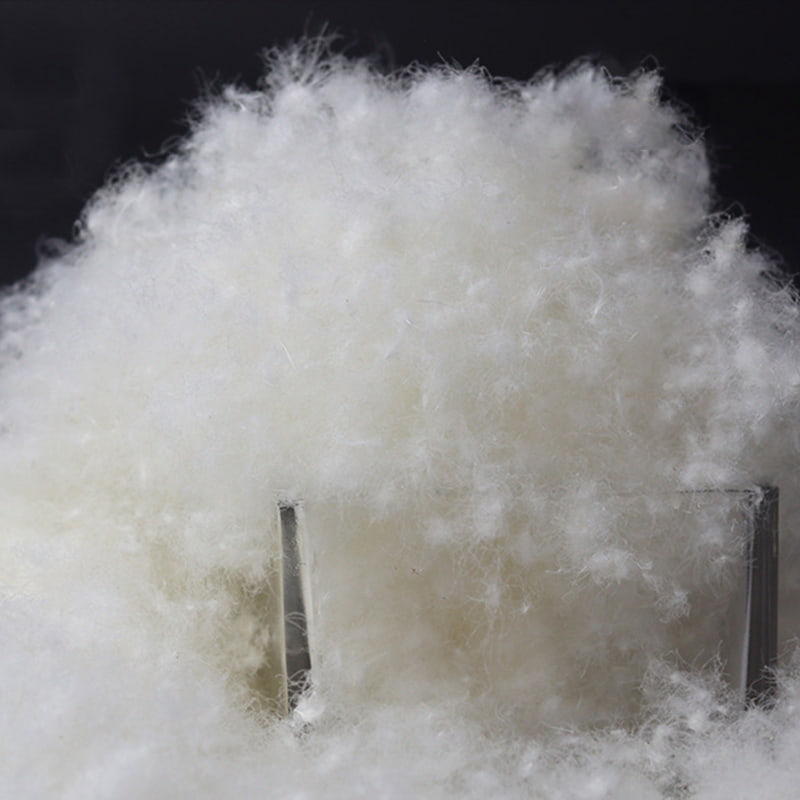 90% Pure White Duck DownOriginated from the duck's abdomen, neck, wings and other high-quality down-producing parts, the down presents a natural reed-like clustered shape with excellent fluff...View Product →
Where in the World Down Feathers Are Produced
China is the center of gravity for global down production. Industry estimates place roughly 80 percent of supply there, with Hungary, Poland, Vietnam and France supplying most of the remainder. The reason is arithmetic rather than mystique: China farms ducks and geese at a scale no other region matches, and down is the residual stream of that meat output.
Estimated share of global down production by country or region
China80%
Hungary6%
Poland4%
Vietnam4%
France3%
Others3%
Approximate estimates compiled from industry reporting; exact shares shift year to year with meat output and demand.
270,000 tannual global output
80%estimated share from China
$7.5Bprojected market by 2027
Geography still matters at the margin. Hungarian and Polish goose down carries a premium in European bedding, while many Asian buyers spec white duck down for its balance of cost and performance. Haining, in Zhejiang's Yangtze delta textile belt, puts a processor within reach of both raw material channels and the export ports of Shanghai and Ningbo. In practice, species, bird maturity and washing discipline predict fill quality better than the country on the invoice.
How Down Is Collected: Four Routes to a Bulk Bag
Most commercial down is stripped from birds after slaughter; a smaller share is gathered from live birds as it loosens naturally, and a sliver is hand-collected from eider nests. A fourth route, live plucking, is banned by every major certification and is exactly what audits exist to catch.
- Post-slaughter collection. Ducks and geese are raised for meat; after processing, the plumage is stripped and sold into the fill trade. Industry bodies treat this as the normal channel, which is why down is called a byproduct.
- Live gathering. Loose down is collected from flooring during natural molts; in parts of Asia this happens up to four times a year. No cutting is involved when it is done properly.
- Eiderdown harvesting. Farmers in Iceland and a few Nordic sites collect the down eiders shed into their nests once the season ends.
- Live plucking. Feathers pulled from restrained live birds. The Responsible Down Standard, Downpass and comparable schemes prohibit it outright.
Whatever the route, raw material then passes through one industrial pipeline: sorting to separate clusters from feathers, washing in mild detergent, repeated rinsing, high-temperature sterilization, drying and dust removal. Grading comes last, splitting output into the 50, 80 and 90 percent content tiers buyers quote. An 80 percent grey duck grade is a typical mid-tier output of that line, balancing cost against performance for value bedding programs.
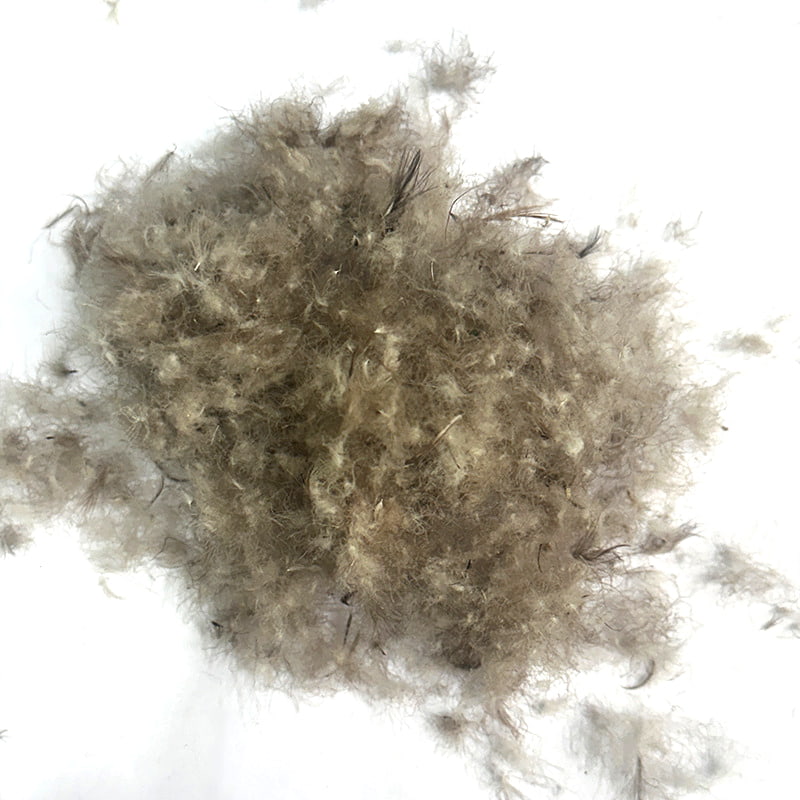 80% Grey Duck DownThe fine down from the abdomen, neck and wings of high-quality grey ducks is carefully selected. The down has a natural reed-like fluffy structure, forming a natural w...View Product →
How Down Is Graded: Content Percentages and Fill Power
Two numbers do most of the talking on a down label. The first is down content, written as 50, 80 or 90 percent: the share of down clusters versus small feathers in the bag. The second is fill power, the volume in cubic inches that one ounce of fill lofts to, commonly between 500 and 900.
- Down content percentage, verified per batch rather than per brochure.
- Fill power result, ideally tested to the IDFB method.
- Cleanliness data such as oxygen number and turbidity, which reflect washing quality.
- Species and color documentation, since white and grey down price differently.
- Traceability paperwork linking the lot to certified farms.
A label that says "down" without a content percentage or a fill number is a price signal, not a specification.
At the top of the range, 90 percent white goose down is the grade that high-loft winter duvets and expedition-weight jackets are engineered around, and it is the tier where cluster size and cleanliness separate good lots from great ones.
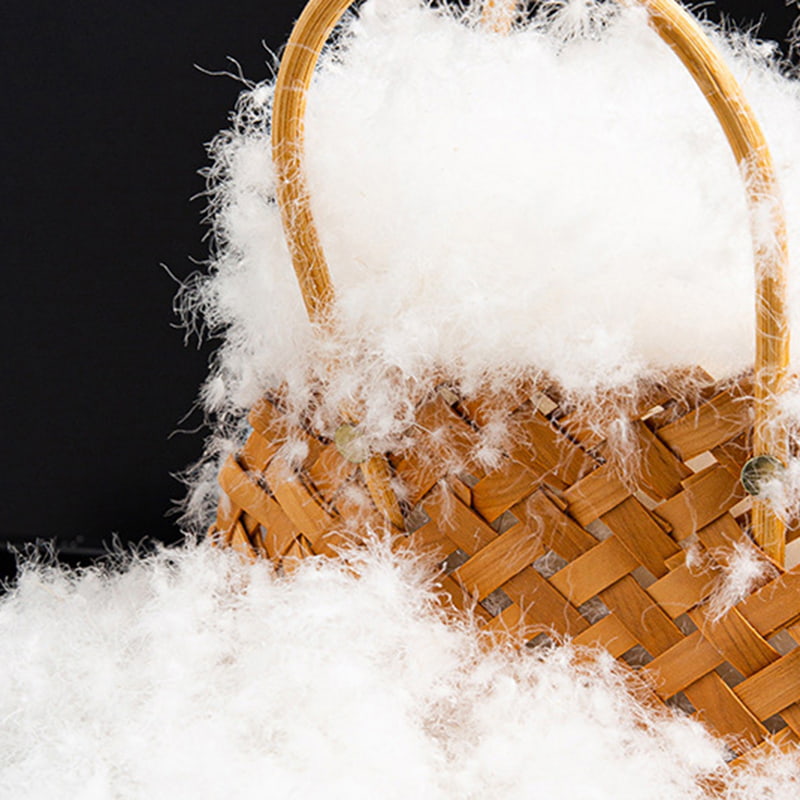 90% White Goose DownOriginated from the core down-producing areas of the abdomen, neck and wings of selected white geese, the natural down has a delicate reed-like clustered structure, fo...View Product →
Ethical Sourcing: How Buyers Verify Where Down Came From
Because poor practice exists somewhere in any global trade, down buyers lean on third-party certification schemes: the Responsible Down Standard (RDS), the Global Traceable Down Standard, Downpass and the International Down Standard. These frameworks audit the chain from farm to finished fill and certify that material comes from slaughterhouse byproduct channels rather than banned practices.
What the standards prohibit
- Live plucking of breeding or meat birds
- Force feeding
- Blending untraceable lots of unknown origin
What the standards require
- Chain-of-custody documents from farm to factory
- Third-party audits of suppliers
- Documented welfare controls at slaughter
For a procurement team, the practical move is to ask for the certificate number and its scope, then match it against the specific lot being offered. Established processors selling into European and American markets hold these certificates and produce the records on request; a supplier that hesitates to document origin is answering the question anyway.
Frequently Asked Questions About Down Origins
Do ducks and geese die for their down?
No. Birds are raised for meat, and down is collected as a byproduct after processing. That byproduct model is what produces roughly 270,000 metric tons of down and feather each year.
Which country do most down feathers come from?
China, which industry estimates credit with about 80 percent of global production. Hungary and Poland are the best-known European sources of goose down, and eiderdown comes mainly from Iceland.
Is down collected from live birds?
Loose down is sometimes gathered from live birds during natural molts, which can happen up to four times a year in some systems. Live plucking, by contrast, is banned under the Responsible Down Standard and similar schemes, and certified material excludes it.
How can a buyer confirm where a down lot came from?
Ask for the down content percentage, a fill power test result and traceability or RDS documents tied to the specific lot, then work with an established processor that can produce certification records on request. Common sourcing and quality questions are also answered on the FAQ page.
News Center
If you are interested in our products, please consult us
Contact Details
- Address : East 1st Floor, Building 3, No.3 Light Textile Road, Xucun Town, Haining City, Jiaxing City, Zhejiang Province
- Tel: +86-18133691685
- E-mail: [email protected]
Products
Quick Link
News Center
Mobile terminal

